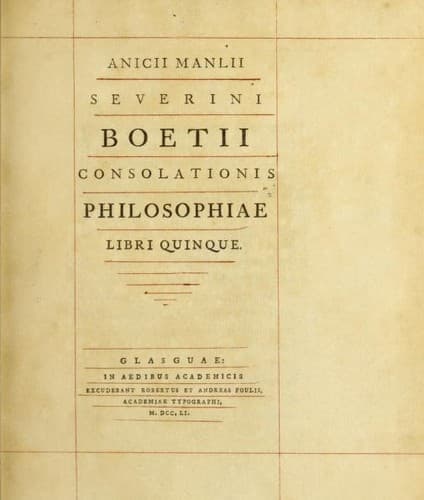
Chaucer's Translation of Boethius's "De Consolatione Philosophiae"Boethius
ReligionComparative
Chaucer's Translation of Boethius's "De Consolatione Philosophiae"
Boethius
Happiness; Philosophy and religion
A philosopher, liberal of his wealth and parsimonious of his time, might
be insensible to the common allurements of ambition, the thirst of gold
and employment. And some credit may be due to the asseveration of
Boethius, that he had reluctantly obeyed the divine Plato, who enjoins
every virtuous citizen to rescue the state from the usurpation of vice
and ignorance. For the integrity of his public conduct he appeals to the
memory of his country. His authority had restrained the pride and
oppression of the royal officers, and his eloquence had delivered
Paulianus from the dogs of the palace. He had always pitied, and often
relieved, the distress of the provincials, whose fortunes were exhausted
by public and private rapine; and Boethius alone had courage to oppose
the tyranny of the Barbarians, elated by conquest, excited by avarice,
and, as he complains, encouraged by impunity. In these honourable
contests his spirit soared above the consideration of danger, and
perhaps of prudence; and we may learn from the example of Cato, that a
character of pure and inflexible virtue is the most apt to be misled by
prejudice, to be heated by enthusiasm, and to confound private enmities
with public justice. The disciple of Plato might exaggerate the
infirmities of nature, and the imperfections of society; and the mildest
form of a Gothic kingdom, even the weight of allegiance and gratitude,
must be insupportable to the free spirit of a Roman patriot. But the
favour and fidelity of Boethius declined in just proportion with the
public happiness; and an unworthy colleague was imposed to divide and
control the power of the master of the offices. In the last gloomy
season of Theodoric, he indignantly felt that he was a slave; but as his
master had only power over his life, he stood without arms and without
fear against the face of an angry Barbarian, who had been provoked to
believe that the safety of the senate was incompatible with his own. The
Senator Albinus was accused and already convicted on the presumption of
_hoping_, as it was said, the liberty of Rome.
Public-domain text, read in full here on John Shaqi.
Reviews
Reviews
No reviews yet
Be the first to share your thoughts on this work.
Join the Discussion
Join the discussion
Sign in to leave a comment or review.
Sign InorCreate an account