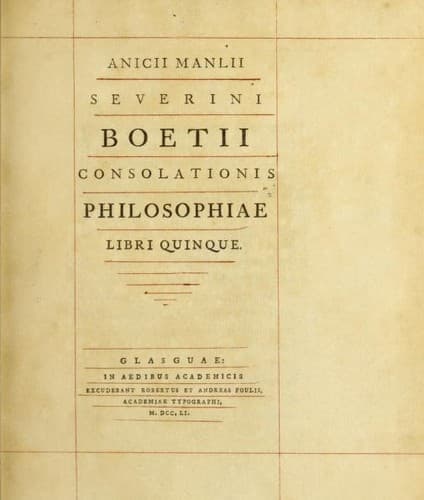
Chaucer's Translation of Boethius's "De Consolatione Philosophiae" — John Shaqi
Chaucer's Translation of Boethius's "De Consolatione Philosophiae"Boethius
ReligionComparative
Chaucer's Translation of Boethius's "De Consolatione Philosophiae"
Boethius
Happiness; Philosophy and religion
[Linenotes:
300 _drow_--MS. drowe, C. weth drowh
_ȝitte_--yit
_wrong_--wronge
301 _rychesse_--richesses
_þe_ (2)--omitted
302 _harmed eyþer_--harmyd or amenused owther
303 _tributis_--tributȝ
_suffred[e]_--suffreden
304 _harme_--harm
305 _ȝere_--yer
_hys_--hise
305, 306, 307 _corne_--corn
306 _schold[e] bie_--sholde byen
308 _But I withstod_--Boece withstood (MS. withstode)
_com_--MS. come, C. com
311 _swiche_--swich
312 _bouȝt[e]_--bowhte
_busshel_--bossel
_most[e] ȝeue_--moste yeue
315 _inplitable_--vnplitable
_seyn_--sayen
319 _ouercom_--MS. ouercome, C. ouer com
320 _counseiller_--consoler
_rychesse_--rychesses
321 _whyche_--which
322 _wolde_--wolden
323 _drow_--MS. drowe, C. drowh
324 _myche_--moche
326 _punischen_--punisse
327 _putt[e]_--putte
328 _yseyn_--MS. yseyne
329 _greet[e]_--grete
330 _aughte be_--owhte be the
_oþer_--oothre
333 _by þe whiche_--by which
_þoruȝ þe_--thorw tho]
[Headnote:
THE ACCUSERS OF BOETHIUS.]
[Sidenote: Boethius makes mention of his accusers, Basilius,
Opilio, Gaudentius, men who had been commanded to leave the city
on account of their many crimes.]
¶ Of þe noumbre of whiche accuso{ur}s one basilius þat somtyme
was chased out of þe kynges seruice. is now co{m}pelled 336
i{n} accusyng of my name for nede of foreine
moneye. ¶ Also opilion {and} Gaudenci{us} han accused
me. al be it so þat þe Iustice regal hadde su{m}tyme demed
hem boþe to go in to exil. for her treccheries {and} fraudes 340
wiþ-outen noumbre. ¶ To whiche iugement þei wolde
not obeye. but defended[e] hem by sykernesse of holy
houses.
[Sidenote: [* fol. 6.]]
*þat is to seyne fledden in to seyntuaries. {and}
whan þis was ap{er}ceiued to þe kyng. he comaunded[e] 344
but þat þei voided[e] þe citee of Rauenne by certeyne
day assigned þat men scholde merken hem on þe forheued
wiþ an hoke of iren {and} chasen hem out of toune.
¶ Now what þing semeþ þe myȝt[e] be lykned to þis 348
cruelte.
[Sidenote: But, on the day this sentence was to be executed, they
accused him, and their testimony against him was accepted.]
For certys þilk same day was receyued þe accusyng
of my name by þilk[e] same accuso{ur}s. ¶ What
may be seid herto. haþ my studie {and} my konnyng
deserued þus. or ellys þe forseide dampnaciou{n} of me. 352
made þat hem ryȝtful accuso{ur}s or no (q.d. no{n}).
[Sidenote: Fortune, if not ashamed at this, might at least blush
for the baseness of the accusers.]
¶ Was not fortune asshamed of þis. [Certes alle hadde
nat fortune ben asshamyd] þat i{n}nocence was accused.
ȝit auȝt[e] sche haue had schame of þe filþe of myn accuso{ur}s. 356
Public-domain text, read in full here on John Shaqi.
Reviews
Reviews
No reviews yet
Be the first to share your thoughts on this work.
Join the Discussion
Join the discussion
Sign in to leave a comment or review.
Sign InorCreate an account