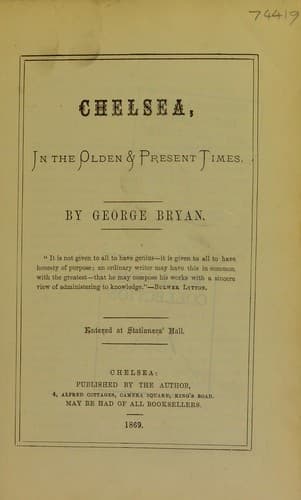
Chelsea, in the Olden & Present Times — John Shaqi
Chelsea, in the Olden & Present TimesBryan, George
History
Chelsea, in the Olden & Present Times
Bryan, George
Chelsea (London, England) -- History
Erasmus gives a pleasing description of the manner of More’s living with
his wife and family at Chelsea. “There he conversed with his wife,” says
he, “his son, his daughter-in-law, his three daughters and their
husbands, with eleven grand-children. There is not a man living so
affectionate to his children as he; he loveth his old wife as well as if
she was a young maid.” Fox, in his Martyrology, however, throws a sad
blast over the character of More. He states that More used to bind
heretics to a tree in his garden, called “The Tree of Troth,” but this
was denied by More himself. Henry VIII., to whom he owed his rise and
fall, frequently came to Chelsea to visit him. Sometimes the king would
ascend to the house-top with him to observe the stars and converse on
astronomy. Amongst the illustrious foreigners entertained and patronised
by Sir Thomas More, may be mentioned Hans Holbein, a celebrated painter,
who lived with him for nearly three years painting portraits of him, his
relations, and friends. It is generally admitted that he had a house in
Chelsea for aged people, whom he daily relieved.
* * * * *
More delighted in telling the following “merrie story,” as he termed
it:—A friar while preaching “spyed a poore wyfe of the paryshe whysperyng
to her pew-fellow, and he fallyng angry thereto, cryde out unto her
aloude, ‘Hold thy babble, I byd thee, thou wyfe in the red hood!’” He
regularly attended Chelsea Church, and very often assisted at the
celebration of Mass, and at times he would put on a surplice and join the
quire.
* * * * *
The pathetic story of More’s wit was never so touchingly illustrated as
on the day after he resigned the Great Seal. He went to Chelsea Church
as usual with his wife and family, none of whom he had yet informed of
his resignation. During the service, as was his custom, he sat in the
choir, in a surplice. After service it was the custom for one of his
attendants to go to her ladyship’s pew, and say, “My Lord is gone
before.” But this day the Ex-Chancellor came himself, and making a low
bow, said, “Madam, my Lord is gone.” Then, on their way home, to her
great mortification, he unriddled his mournful pleasantry by telling her
his lordship was gone, in the loss of his official dignities.
* * * * *
Sir Thomas had four children, three daughters and one son; the latter was
the youngest. His first wife wished very much for a boy; at last she
brought this son, who proved to be of slender capacity; upon which he
said to her, “You have prayed so long for a boy, that now you have got
one that will be a boy as long as he lives.” The good lady walked away
from him.
* * * * *
Public-domain text, read in full here on John Shaqi.
Reviews
Reviews
No reviews yet
Be the first to share your thoughts on this work.
Join the Discussion
Join the discussion
Sign in to leave a comment or review.
Sign InorCreate an account