Chelsea, in the Olden & Present Times — John Shaqi
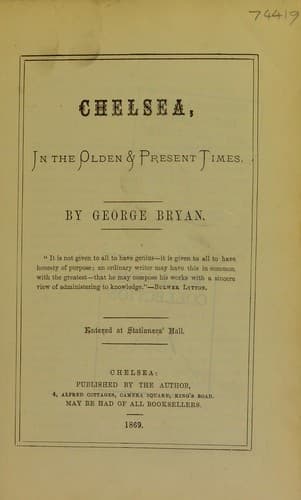
Chelsea, in the Olden & Present TimesBryan, George
History
Chelsea, in the Olden & Present Times
Bryan, George
Chelsea (London, England) -- History
By indefatigable application, More cleared the Court of Chancery of all
its causes. One day, having ended a cause, he called for the next, and
was told there was “no other depending in the Court.” He was delighted
to hear it, and ordered it to be inserted on the records of the Court.
It gave rise to the following epigram, not the worst in the English
language:—
“When More some time had Chancellor been
No More suits did remain;
The same shall never More be seen
Till More be there again.”
The pitiful story of More’s daughter, Margaret, parting with her beloved
father, on the morning of his cruel execution, is truly affecting. She
followed him to the scaffold—embraced him, implored his blessing, wept
upon his cheek, bidding him in anguish adieu. A second time she went
forward to him, clung round his neck and kissed him, when at last,
notwithstanding his apparent gravity, tears fell from his eyes * * * and
soon afterwards she was severed from him for ever! It appears that his
original intention to be interred in the Old Church, was unhappily not
fulfilled. Dr. King states that “his body was buried in the chapel of
St. Peter, in the Tower, and his head, after some months, was bought by
his daughter, Margaret, and taken down from London Bridge, where it was
fixed upon a pole, and was buried,” probably as stated, in St. Dunstan’s,
near Canterbury. Aubery, however, asserts that “after he was beheaded,
his trunke was interred in Chelsey Church, near the middle of the south
wall, where was some slight monument erected, which being worne by time,
Sir John Lawrence, of Chelsey, at his own proper costs and chardges,
built to his memorie a handsome one, with inscription, of marble.” This
statement, as regards the interment of Sir Thomas More’s body, does not
accord with the opinion of most other writers on the subject.
* * * * *
After the death of More, his mansion was granted in the 28th of Henry
VIII. to Sir William Paulet, afterwards Marquis of Winchester, to whom
Edward VI. granted in fee both that and all other premises in Chelsea and
Kensington, forfeited by his attainder.
* * * * *
Public-domain text, read in full here on John Shaqi.
Reviews
Reviews
No reviews yet
Be the first to share your thoughts on this work.
Join the Discussion
Join the discussion
Sign in to leave a comment or review.
Sign InorCreate an account