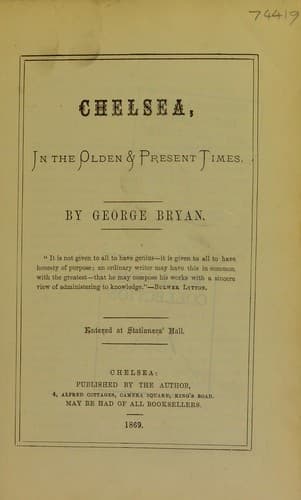
Chelsea, in the Olden & Present TimesBryan, George
History
Chelsea, in the Olden & Present Times
Bryan, George
Chelsea (London, England) -- History
The Marquis of Winchester, who was so much of a courtier as to
accommodate himself to princes as well as to subjects of very different
characters, was, from his natural and acquired abilities, perfectly
qualified to act with propriety in the highest offices of the state. In
the reign of Edward VI. he was made Lord High Treasurer of England. It
is said that by his councils, in a great measure, the Duke of
Northumberland’s design of setting the Lady Jane Grey on the throne was
prevented; for which good office of loyalty to them, the Queens, Mary and
Elizabeth, continued him in the Treasurer’s Office, which he enjoyed for
thirty years; and on being asked how he preserved himself in that place
through so many changes of government, he answered, “By being a willow,
and not an oak.” He died in 1572, aged 97 years. The marquis greatly
enlarged and improved the house, and, according to Norden, “adorned
Chelsea with stately buildings.” His eldest son, John, second Marquis of
Winchester, died at Chelsea in 1576. The widow of the first marquis died
in 1586.
* * * * *
Gregory, Lord Dacre, soon afterwards had possession of Sir Thomas More’s
house. He was the son of Thomas Fynes Lord Dacre, who succeeded his
grandfather in the 26th of Henry VIII.; and who, in 1541, was engaged
with some other persons in chasing the deer in Sir Nicholas Pelham’s
park, when a fray arising between them and the keepers, in which one of
the latter was killed, he was found guilty of being accessary to the
murder, and suffered death accordingly; but his children were restored to
their honours in the reign of Queen Elizabeth. Gregory, Lord Dacre, died
at Chelsea in 1594, without issue; and his sister Margaret, the wife of
Samuel Lennard, Esq., claimed the barony, and was allowed it in the
second of James I.
* * * * *
Lady Dacre survived her husband but a few months, and bequeathed her
house at Chelsea, with all its appurtenances, to the great Lord Burleigh,
with remainder to his son Robert, afterwards Earl of Salisbury, and Lord
High Treasurer. “I have seen,” says Lysons, “among the records at the
Rolls Chapel, a pardon of alienation to Sir Robert Cecil, dated June 21,
39th Elizabeth, for acquiring these premises of Thomas Lord Buckhurst.”
This distinguished nobleman, afterwards Earl of Dorset, was brother to
Lady Dacre, and resided frequently with his sister at Chelsea, but it is
not known whether he had any interest in the estate.
* * * * *
The Earl of Salisbury is supposed to have rebuilt Sir Thomas More’s
house, as the initials of his name were to be seen on the pipes and in
several of the rooms.
* * * * *
Public-domain text, read in full here on John Shaqi.
Reviews
Reviews
No reviews yet
Be the first to share your thoughts on this work.
Join the Discussion
Join the discussion
Sign in to leave a comment or review.
Sign InorCreate an account