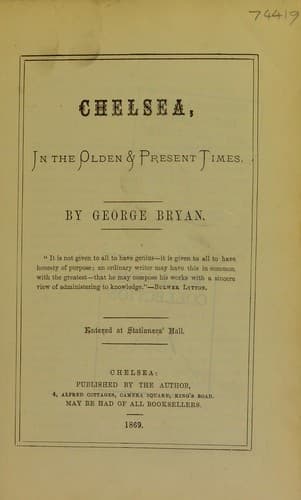
Chelsea, in the Olden & Present TimesBryan, George
History
Chelsea, in the Olden & Present Times
Bryan, George
Chelsea (London, England) -- History
Henry Clinton, Earl of Lincoln, bought the house of the Earl of
Salisbury, and probably came immediately to reside in it, as there are
some entries respecting his family in the Parish Register in the
beginning of the year 1609. By his first wife, Lady C. Hastings,
daughter of Francis, Earl of Huntingdon, he had two sons, Thomas, his
successor in the title, and Edward; and by his second wife, widow of W.
Norris, Esq., he had a daughter, Elizabeth, who married Sir Arthur
Gorges, and also two sons, Henry and Robert. The latter died in 1609,
and was buried at Chelsea.
* * * * *
Sir Arthur Gorges, on the death of Henry, Earl of Lincoln, became the
possessor of the house, and he and Lady Elizabeth, his wife, in
consideration of £4300, sold it to Sir Lionel Cranfield, afterwards
created Earl of Middlesex. It was described as the “greatest house at
Chelsea, with two fore great courts adjoining, environed with brick
walls, also a wharf (landing-place for a pleasure boat, &c.) lying in
front, having a high brick tower on the east and west ends, and a high
water tower, standing upon the west corner of the wharf, and the
watercourse belonging thereto. An orchard, a garden, having a peryment
standing up in the middle, and a terrace on the north end thereof, with a
banquetting house at the east end of the terrace, having a marble table
in it. A great garden, dovecote close, containing five acres, the
kitchen garden, brick-barne close, containing ten acres.” Lord Middlesex
held the mansion till 1625, when he sold it to Charles I., who, in 1627,
granted the said house, &c., to the Duke of Buckingham.
* * * * *
Public-domain text, read in full here on John Shaqi.
Reviews
Reviews
No reviews yet
Be the first to share your thoughts on this work.
Join the Discussion
Join the discussion
Sign in to leave a comment or review.
Sign InorCreate an account