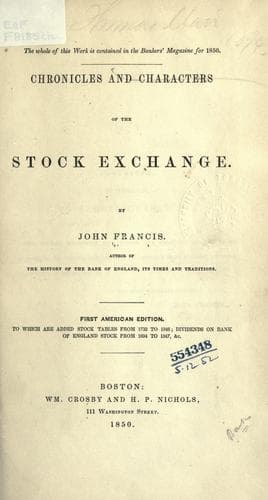
Chronicles and characters of the stock exchangeFrancis, John, of the Bank of England
History
Chronicles and characters of the stock exchange
Francis, John, of the Bank of England
Speculation; Stock Exchange (London, England)
The corrupt transactions which tended so greatly to increase the
national debt are very remarkable. The assembled Commons declared in
a solemn vote, “it is notorious that many millions are unaccounted
for.” Mr. Hungerford was expelled from the lower house for accepting
a bribe of £21; and the Duke of Leeds impeached for taking one of
5,500 guineas. The price of a speaker—Sir John Trevor—was £1,005,
and the Secretary to the Treasury was sent to the Tower on suspicion
of similar practices. Money-receivers lodged great sums of public
money with the goldsmiths at the current interest. Others lent
the exchequer its own cash in other persons’ names; and out of 46
millions raised in 15 years, 25 millions were unaccounted for. The
Commissioners of Hackney-coaches were accessible, and peculation in
the army was discovered by a chance petition of the dwellers in a
country town. By this it appeared that the inhabitants of Royston in
Hertfordshire had large claims made upon them for money, by colonels,
captains, and cornets, in addition to the food and lodging which
was their due. A few independent members took up the question; the
public supported them; and at this juncture a book was delivered at
the lobby of the house, which asserted that the public embezzlement
was as enormous as it was infamous, and that the writer was prepared
to make discoveries which would astonish the world. The offer was
accepted; a searching inquiry was made, and defalcations were
discovered so great, that all wonder ceased at the increase of the
national debt, and at the decrease of the national glory. The abuses
in clothing the army were plain and palpable. The agents habitually
detained the money due to the soldiers, and used it for their own
advantage, or compelled them to pay so large a discount, that they
were in the utmost distress.
The subaltern officers were not better off. Colonel Hastings,
afterwards cashiered for the offence, made them buy their raiment
of him. If they hesitated, he threatened; if they refused, he
confined them. In 1693, an inquiry was made into the application of
the secret-service money, when great and deserved animadversion was
passed upon those through whom it circulated. The power possessed by
government under such abuses may be imagined. They were sure of the
votes of those who had places and pensions, and they were sure also
of the votes of that large class of expectants which always haunts a
profuse ministry; and thus “the courtiers,” as the ministerial party
was long designated, could baffle any bills, quash all grievances,
stifle any accounts, and raise any amount of money.
Public-domain text, read in full here on John Shaqi.
Reviews
Reviews
No reviews yet
Be the first to share your thoughts on this work.
Join the Discussion
Join the discussion
Sign in to leave a comment or review.
Sign InorCreate an account