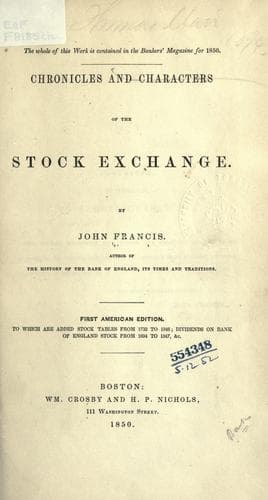
Chronicles and characters of the stock exchange — John Shaqi
Chronicles and characters of the stock exchangeFrancis, John, of the Bank of England
History
Chronicles and characters of the stock exchange
Francis, John, of the Bank of England
Speculation; Stock Exchange (London, England)
These discoveries inflamed the people, and murmurs that corruption
had eaten into the nation became general. Court and camp, city and
senate, were alike denounced. The pamphleteers spoke in strong
language. “Posterity,” said the author of one, termed The Price
of the Abdication, “will set an eternal brand of infamy upon
those members, who, to obtain either offices, profitable places,
or quarterly stipends, have combined to vote whatever hath been
demanded.”
It has been the fashion of a certain class to decry William because
he founded the national debt. But the war which he waged was almost
a war of necessity, and could not be supported without liberal
supplies. There was, however, with William a personal pride in the
contest. He had been taught, from his boyhood, hatred to France, and
almost in boyhood had checked the universal dominion aimed at by
Louis. With him, therefore, opposition to France was a passion; and
he who, at the age of twenty-three, bade defiance to the combined
power of the two greatest nations of the modern world, remembered,
as soon as he reached the English throne, that proud, though bitter
moment, when, surrounded by French force, his people determined to
let loose the waters which their skill had confined, and from the
homes and hearths of their fathers bear their goods, their fortunes,
and their persons, and to erect in a new land the flag they would
not see dishonored in the old. When, therefore, William of Orange
became monarch of England, his first thought was the humiliation of
France. To this point he bent the vast energies of England and his
own unconquerable will; for this only was his crown valuable, and for
this purpose was the power of England strained to the utmost tension.
The importance of France was then at its height. Louis sought to sway
the councils of Europe; and whoever else might have succumbed, the
statesmen of England had been in his power, and a monarch of England
in his pay. He saw, therefore, with dislike which was not attempted
to be concealed, the throne mounted by one who was resolved, not
merely to maintain its ancient greatness, but to quell the power of
its ancient rival. Louis sheltered the abdicated king, and encouraged
his mock court and his mock majesty. This was sufficient proof of his
feeling; nor were other indications wanting: and it is a complete
fallacy to suppose that the debt was unnecessarily incurred; in it
lay the power of William and the safety of the land.
Public-domain text, read in full here on John Shaqi.
Reviews
Reviews
No reviews yet
Be the first to share your thoughts on this work.
Join the Discussion
Join the discussion
Sign in to leave a comment or review.
Sign InorCreate an account