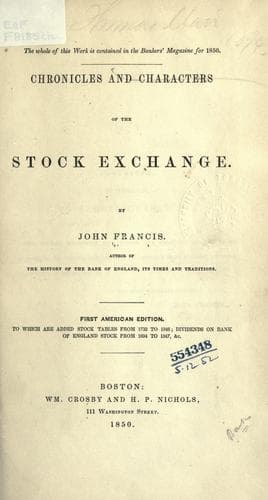
Chronicles and characters of the stock exchangeFrancis, John, of the Bank of England
History
Chronicles and characters of the stock exchange
Francis, John, of the Bank of England
Speculation; Stock Exchange (London, England)
Had the new king employed the arbitrary mode of levying supplies
of the earlier monarchs; had he made forced loans and never repaid
them; had he seized upon public money, and wrung the purses of public
men, the country might as well have been governed by a James as a
William, and would in all probability have recalled the exile of the
unfortunate House of Stuart. The evils of William’s reign were in
the facts that his power was not sufficiently established to borrow
on equitable terms; that the bribery, abuses, and corruption of men
in high places increased with their position; and, above all, that,
instead of paying his debts by terminable annuities, he made them
interminable. Lord Bolingbroke declares, that he could have raised
funds without mortgaging the resources of the nation in perpetuity,
and that it was a political movement to strengthen the power of the
crown, and to secure the adherence of that large portion of the
people by whom the money had been lent.
The war was necessary, and the contraction of the debt equally so;
for, although William engaged in the contest with something like
personal pride, it was essentially a national war. A free people
had driven away the Stuarts; a despotic king would have forced them
back. If ever, therefore, a contest directly interested both subject
and sovereign, it was that which created the national encumbrance;
and England was fortunate in the man she had chosen to champion
her rights. The contest, which dated from 1688 and ended in 1697,
which cost us 20 millions in loans and 16 millions in taxes, was
only closed because both nations were fatigued. It produced no great
results, no grand achievements, no lasting peace. It did but prove
that the strength which had departed from England during the two
previous reigns had slumbered, but was not withered. The earlier
history was, as many of England’s great wars have been, comparatively
unsuccessful. The parties into which the nation was divided prevented
the unanimity necessary to great deeds. They agreed only in robbing
the people. Public principle was with them a public jest. Incapacity
and corruption pervaded all branches. By corruption a Parliamentary
majority was procured, and through incapacity the commerce of the
country was decaying. Talent was only employed in devising its own
benefit; patriotism was perverted; national virtue was forgotten; and
the allies found that on sea and land the enemy had the advantage.
The navy was daring, but divided; the admirals were accused of
disaffection. While the foe was intercepting our merchandise in
the Channel, the vessels of England were building in the docks. On
the sea, our own peculiar boast, we were dishonored; our flag was
insulted; and English admirals retreated before French fleets. Ships
of war were burnt; merchant-vessels were sunk; and a million of
merchandise was destroyed.
Public-domain text, read in full here on John Shaqi.
Reviews
Reviews
No reviews yet
Be the first to share your thoughts on this work.
Join the Discussion
Join the discussion
Sign in to leave a comment or review.
Sign InorCreate an account