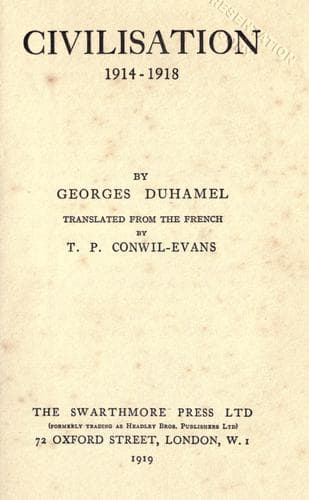
Short stories, French -- Translations into English; World War, 1914-1918 -- Fiction
Sometimes, unutterably wearied by so much suffering, I asked for work
outside the camp, in order to sort out my ideas and renew the theme of
my reflections. It was always with a sigh of comfort that I got away
from the city of tents. I contemplated, from a distance, this sinister
agglomeration, which certainly bore comparison with an itinerant fair.
I tried to distinguish amid the white canvas and red crosses the
tops of these little “mosques.” I gazed also at the cemetery where
hundreds and hundreds of bodies had been buried; and, realising the
sum of the misery, despair and rage accumulated on that spot of the
earth, I thought of the people who, far away in the heart of France,
were crowding the concert cafés, the drawing-rooms, the cinemas, the
brothels, finding brazen enjoyment in themselves, in the world, in the
weather; and, sheltered by this quivering rampart of the sacrificed,
will not share in this universal anguish. I thought of these people
with more shame than resentment.
The excursions in the open freshened me a little, and I found some
comfort in the sight of healthy men spared by the battle.
Sometimes I went as far as the English sector. Masses of long-range
artillery were to be seen there. The guns were served by soldiers in
shirt-sleeves and long trousers stained by oil and cart-grease. They
looked more like factory workers than soldiers. You felt then how war
has become an industry--an engineering business devoted to mechanical
slaughter and massacre.
One night, walking along the Albert road, I overheard the conversation
of some men who were sitting on the upturned earth of a pit. By their
accent they were peasants from the north and must have belonged to the
regiments which had just been under fire.
“After the war,” said one of them, “those who are going to dabble in
politics, they’ll have to say they had a hand in this confounded war.”
But this frank opinion, caught in passing one night along a road in the
front--this inconsequent, unanswered comment was lost in the tumult of
the gunfire.
* * * * *
I gained much by being stretcher-bearer. I came to know the men better
than I had ever done until then--to know them bathed in a purer light,
_naked_ before death, stripped even of the instincts which disfigure
the divine beauty of simple souls.
In the midst of the greatest trials our race of peasants has remained
vigorous, pure, worthy of the noblest human traditions. I have known
them--Rebic, Louba, Ratier, Freyssinet, Calmel, Touche, and so many
others whom I must not name if I am not to mention the whole country.
It cannot be said that pain chose its victims, and yet, when I used
to pass by their beds where their destiny struggled--when I looked at
their faces, each one of them, they all seemed to me good, patient,
energetic men, and all of them deserved to be loved.
Public-domain text, read in full here on John Shaqi.
Reviews
Reviews
No reviews yet
Be the first to share your thoughts on this work.
Join the Discussion
Join the discussion
Sign in to leave a comment or review.
Sign InorCreate an account