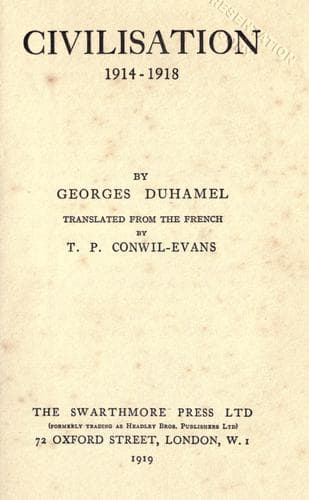
Short stories, French -- Translations into English; World War, 1914-1918 -- Fiction
Mme. Baugan came at eight o’clock, and at once she began scolding:
“There’s a nasty smell about. Oh! Oh! my poor Revaud, I’m sure you have
again----”
Revaud avoided the question:
“Very fine, thanks. I’ve slept very well. Nothing more to report. I’ve
slept quite well.”
Then Mme. Baugan drew back the sheets, and, overcome by the sad and
ignoble smell, she muttered:
“Oh! Revaud! you are unreasonable. Will you never be able to control
yourself!”
Revaud could no longer dissemble. He confessed phlegmatically: “Ah,
it’s true enough! But whatever you say, nurse, I can’t help myself.”
Mme. Baugan came and went, looking for fresh linen and water. She began
to wash him and dress him as if he were a child.
But suddenly overcome with shame and a kind of despair, he moaned:
“Madame Baugan, don’t be cross with me. I wasn’t like that in civil
life.”
Mme. Baugan began to laugh, and Revaud without more ado laughed
too, for all the lines of his face and his whole soul were made for
laughing, and he loved to laugh even in the midst of the most acute
pain.
This reply having pleased him, he trotted it out often, and, when
confessing to his little infirmity, he used to tell everyone “I wasn’t
like that, you know, before I joined up.”
One morning, in making Mery’s bed, Mme. Baugan startled the room with
an exclamation. The paralytic lad had not been able to restrain himself.
“What! Mery! You, too, my poor friend!”
Mery, once a handsome country lad with a splendid body, looked at his
dead limbs and sighed:
“It is quite possible, Madame. I can’t feel what’s going on.”
But Revaud was delighted. All the morning he cried, “It isn’t only me!
It isn’t only me!” And no one grudged him his joy, for when you are in
the depths of despair you are glad to have companions in your misery.
The most happy phrases have only a short-lived success. Revaud, who
had a sense of humour, soon felt the moment coming when he would no
longer find comfort in the remark that “he wasn’t like that before he
joined up.” It was then he received a letter from his father. It came
unexpectedly one morning. Revaud’s face had just been washed, and his
great Gallic moustache had been cut--from caprice--according to the
American pattern. All the hospital filed past at the corner of the door
in order to see Revaud who looked like a very sick “English gentleman.”
He turned the letter over with his fingers that were deformed by misery
and toil; then he said uneasily, “What does the letter mean? Do they
still want to kick up a row?”
Revaud was a married man; but during the six months in which he had
remained without news from his wife he had got used to his loneliness.
He was in his room, behind the door, and sought no quarrels with
anyone. Then why had a letter been sent to him?
“It must be they want to make a row,” he repeated; and he handed the
letter to Mme. Baugan, for her to read.
Public-domain text, read in full here on John Shaqi.
Reviews
Reviews
No reviews yet
Be the first to share your thoughts on this work.
Join the Discussion
Join the discussion
Sign in to leave a comment or review.
Sign InorCreate an account