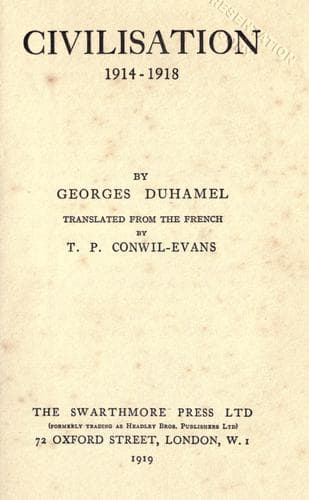
Short stories, French -- Translations into English; World War, 1914-1918 -- Fiction
The letter came from Revaud’s father. In ten lines written in a
painstaking hand, with thick downstrokes and fine upstrokes, with
flourishes and a dashing signature, the old man announced that he was
going to visit him one day in the near future.
Laughter came back again to Revaud, and with laughter a final
justification for living. All day he toyed with the letter, and used
gladly to show it and say:
“We are going to have a visit. My father is coming to see us.”
Then he began to be rather confiding.
“My father, you know, is a fine fellow, but he has had some hard
knocks. You will see my father--he’s a fellow that’s up to a few
tricks, and, what’s worse, he wears a shirt collar.”
Finally he ended by restricting his comments on his father’s character
to this statement:
“My father!--you’ll see--he wears a shirt collar.”
The days passed, and Revaud spoke so often of his father that in the
end he no longer knew whether the visitor had come or was yet to come.
Thus, by a special providence, Revaud never knew that his father did
not come to see him; and afterwards, when wanting to make allusion to
this remarkable period, he had recourse to a very ample phrase, and
used to say:
“It was the time of my father’s visit.”
Revaud was spoiled: he never lacked cigarettes or company, and he used
to confess so contentedly: “I’m the pet of this hospital.”
Besides, Revaud was not difficult. Tarrissant had only to appear
between his crutches for the dying man to exclaim, “Here’s another
who’s come to see me. I told you I was the pet here.”
Tarrissant had undergone the same operation as Revaud. It was a
complicated business, taking place in the knee. Only, in the case of
Tarrissant the operation had been more or less a complete success, and
in the case of Revaud, more or less a failure, because “it depends on
one’s blood.”
From the operation itself Revaud thought he had learned a new word:
“His knee had been ‘dezected.’” He used to look at Tarrissant, and,
comparing himself with the convalescing young man, he came to the
simple conclusion:
“We are both ‘dezected’ men, except that my old woman has left me; and,
too, I have been overworked.”
It was the only allusion that Revaud ever made to his conjugal
misfortune and to his toiling past.
But really, why think of all these things? Hasn’t man enough to do with
a troublesome leg, or this perpetual need which he cannot control?
Public-domain text, read in full here on John Shaqi.
Reviews
Reviews
No reviews yet
Be the first to share your thoughts on this work.
Join the Discussion
Join the discussion
Sign in to leave a comment or review.
Sign InorCreate an account