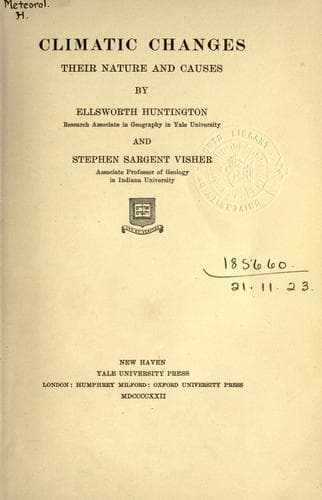
Climatic Changes: Their Nature and CausesHuntington, Ellsworth
Science
Climatic Changes: Their Nature and Causes
Huntington, Ellsworth
Climatic changes; Climatology; Paleoclimatology
These considerations make it fairly certain that for at least several
hundred million years the average temperature of the earth's surface has
never varied more than perhaps 30 deg.C. above or below the present level.
Even this range of 60 deg.C. (108 deg.F.) may be double or triple the range that
has actually occurred. That the temperature has not passed beyond
certain narrow limits, whatever their exact degree, is clear from the
fact that if it had done so, all the higher forms of life would have
been destroyed. Certain of the lowest unicellular forms might indeed
have persisted, for when dormant they can stand great extremes of dry
heat and of cold for a long time. Even so, evolution would have had to
begin almost anew. The supposition that such a thing has happened is
untenable, for there is no hint of any complete break in the record of
life during geological times,--no sudden disappearance of the higher
organisms followed by a long period with no signs of life other than
indirect evidence such as occurs in the Archeozoic.
A change of 60 deg.C. or even of 20 deg. in the average temperature of the
earth's surface may seem large when viewed from the limited standpoint
of terrestrial experience. Viewed, however, from the standpoint of
cosmic evolution, or even of the solar system, it seems a mere trifle.
Consider the possibilities. The temperature of empty space is the
absolute zero, or -273 deg.C. To this temperature all matter must fall,
provided it exists long enough and is not appreciably heated by
collisions or by radiation. At the other extreme lies the temperature of
the stars. As stars go, our sun is only moderately hot, but the
temperature of its surface is calculated to be nearly 7000 deg.C., while
thousands of miles in the interior it may rise to 20,000 deg. or 100,000 deg. or
some other equally unknowable and incomprehensible figure. Between the
limits of the absolute zero on the one hand, and the interior of a sun
or star on the other, there is almost every conceivable possibility of
temperature. Today the earth's surface averages not far from 14 deg.C., or
287 deg. above the absolute zero. Toward the interior, the temperature in
mines and deep wells rises about 1 deg.C. for every 100 meters. At this rate
it would be over 500 deg.C. at a depth of ten miles, and over 5000 deg. at 100
miles.
Public-domain text, read in full here on John Shaqi.
Reviews
Reviews
No reviews yet
Be the first to share your thoughts on this work.
Join the Discussion
Join the discussion
Sign in to leave a comment or review.
Sign InorCreate an account