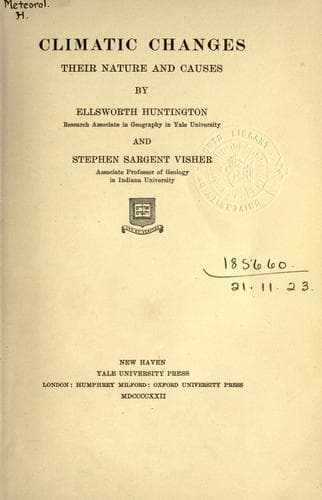
Climatic Changes: Their Nature and Causes — John Shaqi
Climatic Changes: Their Nature and CausesHuntington, Ellsworth
Science
Climatic Changes: Their Nature and Causes
Huntington, Ellsworth
Climatic changes; Climatology; Paleoclimatology
Let us confine ourselves to surface temperatures, which are all that
concern us in discussing climate. It has been calculated by Poynting[5]
that if a small sphere absorbed and re-radiated all the heat that fell
upon it, its temperature at the distance of Mercury from the sun would
average about 210 deg.C.; at the distance of Venus, 85 deg.; the earth 27 deg.; Mars
-30 deg.; Neptune -219 deg.. A planet much nearer the sun than is Mercury might
be heated to a temperature of a thousand, or even several thousand,
degrees, while one beyond Neptune would remain almost at absolute zero.
It is well within the range of possibility that the temperature of a
planet's surface should be anywhere from near -273 deg.C. up to perhaps
5000 deg.C. or more, although the probability of low temperature is much
greater than of high. Thus throughout the whole vast range of
possibilities extending to perhaps 10,000 deg., the earth claims only 60 deg. at
most, or less than 1 per cent. This may be remarkable, but what is far
more remarkable is that the earth's range of 60 deg. includes what seem to
be the two most critical of all possible temperatures, namely, the
freezing point of water, 0 deg.C., and the temperature where water can
dissolve an amount of carbon dioxide equal to its own volume. The most
remarkable fact of all is that the earth has preserved its temperature
within these narrow limits for a hundred million years, or perchance a
thousand million.
To appreciate the extraordinary significance of this last fact, it is
necessary to realize how extremely critical are the temperatures from
about 0 deg. to 40 deg.C., and how difficult it is to find any good reason for a
relatively uniform temperature through hundreds of millions of years.
Since the dawn of geological time the earth's temperature has apparently
always included the range from about the freezing point of water up to
about the point where protoplasm begins to disintegrate. Henderson, in
_The Fitness of the Environment_, rightly says that water is "the most
familiar and the most important of all things." In many respects water
and carbon dioxide form the most unique pair of substances in the whole
realm of chemistry. Water has a greater tendency than any other known
substance to remain within certain narrowly defined limits of
temperature. Not only does it have a high specific heat, so that much
heat is needed to raise its temperature, but on freezing it gives up
more heat than any substance except ammonia, while none of the common
liquids approach it in the amount of additional heat required for
conversion into vapor after the temperature of vaporization has been
reached. Again, water substance, as the physicists call all forms of
H_{2}O, is unique in that it not only contracts on melting, but
continues to contract until a temperature several degrees above its
melting point is reached. That fact has a vast importance in helping to
keep the earth's surface at a uniform temperature.
Public-domain text, read in full here on John Shaqi.
Reviews
Reviews
No reviews yet
Be the first to share your thoughts on this work.
Join the Discussion
Join the discussion
Sign in to leave a comment or review.
Sign InorCreate an account