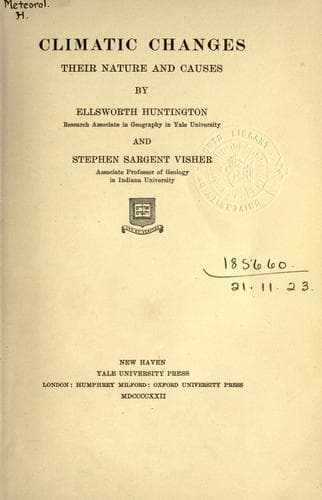
Climatic Changes: Their Nature and Causes — John Shaqi
Climatic Changes: Their Nature and CausesHuntington, Ellsworth
Science
Climatic Changes: Their Nature and Causes
Huntington, Ellsworth
Climatic changes; Climatology; Paleoclimatology
_Early Cenozoic or Eocene and Oligocene time._ Rise of higher
mammals. Glaciers in early Eocene of the Laramide Mountains.
_Late Cenozoic or Miocene and Pliocene time._ Transformation of
ape like animals into man.
_Glacial or Pleistocene time._ Last great ice age.
PRESENT TIME
PSYCHOZOIC ERA. Age of man or age of reason. Includes the present or
"Recent time," estimated to be probably less than 30,000 years.
Moreover, they could live in most latitudes, for the indirect evidences
of life in the Archeozoic and Proterozoic rocks are widely distributed.
Thus it appears that at an almost incredibly early period, perhaps many
hundred million years ago, the earth's climate differed only a little
from that of the present.
The extreme limits of temperature beyond which the climate of geological
times cannot have departed can be approximately determined. Today the
warmest parts of the ocean have an average temperature of about 30 deg.C. on
the surface. Only a few forms of life live where the average temperature
is much higher than this. In deserts, to be sure, some highly organized
plants and animals can for a short time endure a temperature as high as
75 deg.C. (167 deg.F.). In certain hot springs, some of the lowest unicellular
plant forms exist in water which is only a little below the boiling
point. More complex forms, however, such as sponges, worms, and all the
higher plants and animals, seem to be unable to live either in water or
air where the temperature averages above 45 deg.C. (113 deg.F.) for any great
length of time and it is doubtful whether they can thrive permanently
even at that temperature. The obvious unity of life for hundreds of
millions of years and its presence at all times in middle latitudes so
far as we can tell seem to indicate that since the beginning of marine
life the temperature of the oceans cannot have averaged much above 50 deg.C.
even in the warmest portions. This is putting the limit too high rather
than too low, but even so the warmest parts of the earth can scarcely
have averaged much more than 20 deg. warmer than at present.
Turning to the other extreme, we may inquire how much colder than now
the earth's surface may have been since life first appeared. Proterozoic
fossils have been found in places where the present average temperature
approaches 0 deg.C. If those places should be colder than now by 30 deg.C., or
more, the drop in temperature at the equator would almost certainly be
still greater, and the seas everywhere would be permanently frozen. Thus
life would be impossible. Since the contrasts between summer and winter,
and between the poles and the equator seem generally to have been less
in the past than at present, the range through which the mean
temperature of the earth as a whole could vary without utterly
destroying life was apparently less than would now be the case.
Public-domain text, read in full here on John Shaqi.
Reviews
Reviews
No reviews yet
Be the first to share your thoughts on this work.
Join the Discussion
Join the discussion
Sign in to leave a comment or review.
Sign InorCreate an account