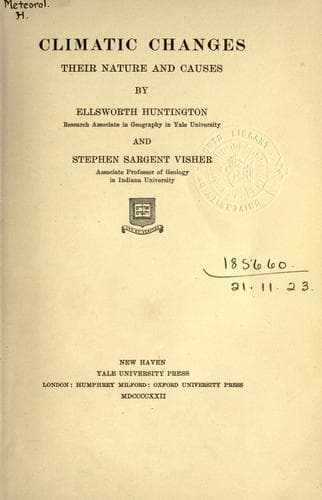
Climatic Changes: Their Nature and CausesHuntington, Ellsworth
Science
Climatic Changes: Their Nature and Causes
Huntington, Ellsworth
Climatic changes; Climatology; Paleoclimatology
If water were like
most liquids, the bottoms of all the oceans and even the entire body of
water in most cases would be permanently frozen.
Again, as a solvent there is literally nothing to compare with water. As
Henderson[6] puts it: "Nearly the whole science of chemistry has been
built up around water and aqueous solution." One of the most significant
evidences of this is the variety of elements whose presence can be
detected in sea water. According to Henderson they include hydrogen,
oxygen, nitrogen, carbon, chlorine, sodium, magnesium, sulphur,
phosphorus, which are easily detected; and also arsenic, caesium, gold,
lithium, rubidium, barium, lead, boron, fluorine, iron, iodine, bromine,
potassium, cobalt, copper, manganese, nickel, silver, silicon, zinc,
aluminium, calcium, and strontium. Yet in spite of its marvelous power
of solution, water is chemically rather inert and relatively stable. It
dissolves all these elements and thousands of their compounds, but still
remains water and can easily be separated and purified. Another unique
property of water is its power of ionizing dissolved substances, a
property which makes it possible to produce electric currents in
batteries. This leads to an almost infinite array of electro-chemical
reactions which play an almost dominant role in the processes of life.
Finally, no common liquid except mercury equals water in its power of
capillarity. This fact is of enormous moment in biology, most obviously
in respect to the soil.
Although carbon dioxide is far less familiar than water, it is almost as
important. "These two simple substances," says Henderson, "are the
common source of every one of the complicated substances which are
produced by living beings, and they are the common end products of the
wearing away of all the constituents of protoplasm, and of the
destruction of those materials which yield energy to the body." One of
the remarkable physical properties of carbon dioxide is its degree of
solubility in water. This quality varies enormously in different
substances. For example, at ordinary pressures and temperatures, water
can absorb only about 5 per cent of its own volume of oxygen, while it
can take up about 1300 times its own volume of ammonia. Now for carbon
dioxide, unlike most gases, the volume that can be absorbed by water is
nearly the same as the volume of the water. The volumes vary, however,
according to temperature, being absolutely the same at a temperature of
about 15 deg.C. or 59 deg.F., which is close to the ideal temperature for man's
physical health and practically the same as the mean temperature of the
earth's surface when all seasons are averaged together. "Hence, when
water is in contact with air, and equilibrium has been established, the
amount of free carbonic acid in a given volume of water is almost
exactly equal to the amount in the adjacent air. Unlike oxygen,
hydrogen, and nitrogen, carbonic acid enters water freely; unlike
Public-domain text, read in full here on John Shaqi.
Reviews
Reviews
No reviews yet
Be the first to share your thoughts on this work.
Join the Discussion
Join the discussion
Sign in to leave a comment or review.
Sign InorCreate an account