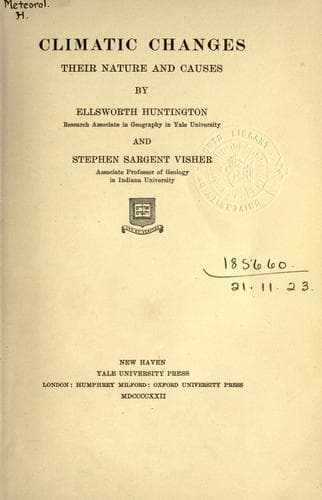
Climatic Changes: Their Nature and CausesHuntington, Ellsworth
Science
Climatic Changes: Their Nature and Causes
Huntington, Ellsworth
Climatic changes; Climatology; Paleoclimatology
sulphurous oxide and ammonia, it escapes freely from water. Thus the
waters can never wash carbonic acid completely out of the air, nor can
the air keep it from the waters. It is the one substance which thus, in
considerable quantities relative to its total amount, everywhere
accompanies water. In earth, air, fire, and water alike these two
substances are always associated.
"Accordingly, if water be the first primary constituent of the
environment, carbonic acid is inevitably the second,--because of its
solubility possessing an equal mobility with water, because of the
reservoir of the atmosphere never to be depleted by chemical action in
the oceans, lakes, and streams. In truth, so close is the association
between these two substances that it is scarcely correct logically to
separate them at all; together they make up the real environment and
they never part company."[7]
The complementary qualities of carbon dioxide and water are of supreme
importance because these two are the only known substances which are
able to form a vast series of complex compounds with highly varying
chemical formulae. No other known compounds can give off or take on atoms
without being resolved back into their elements. No others can thus
change their form freely without losing their identity. This power of
change without destruction is the fundamental chemical characteristic of
life, for life demands complexity, change, and growth.
In order that water and carbon dioxide may combine to form the compounds
on which life is based, the water must be in the liquid form, it must be
able to dissolve carbon dioxide freely, and the temperature must not be
high enough to break up the highly complex and delicate compounds as
soon as they are formed. In other words, the temperature must be above
freezing, while it must not rise higher than some rather indefinite
point between 50 deg.C. and the boiling point, where all water finally turns
into vapor. In the whole range of temperature, so far as we know, there
is no other interval where any such complex reactions take place. The
temperature of the earth for hundreds of millions of years has remained
firmly fixed within these limits.
Public-domain text, read in full here on John Shaqi.
Reviews
Reviews
No reviews yet
Be the first to share your thoughts on this work.
Join the Discussion
Join the discussion
Sign in to leave a comment or review.
Sign InorCreate an account