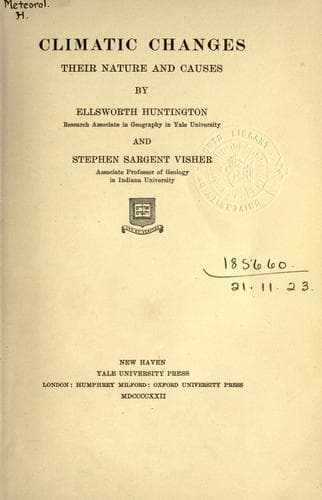
Climatic Changes: Their Nature and CausesHuntington, Ellsworth
Science
Climatic Changes: Their Nature and Causes
Huntington, Ellsworth
Climatic changes; Climatology; Paleoclimatology
These considerations lead to the conclusion that the carbon dioxide
hypothesis and the reversal of the oceanic circulation should be
regarded as a tentative rather than a final explanation of glaciation.
Nevertheless, the action of carbon dioxide seems to be an important
factor in producing the longer oscillations of climate from one
geological era to another. It probably plays a considerable part in
preparing the way for glacial periods and in making it possible for
other factors to produce the more rapid changes which have so deeply
influenced organic evolution.
III. _The Form of the Land._ Another great cause of climatic change
consists of a group of connected phenomena dependent upon movements of
the earth's crust. As to the climatic potency of changes in the lands
there is practical agreement among students of climatology and
glaciation. That the height and extent of the continents, the location,
size, and orientation of mountain ranges, and the opening and closing of
oceanic gateways at places like Panama, and the consequent diversion of
oceanic currents, exert a profound effect upon climate can scarcely be
questioned. Such changes may be introduced rapidly, but their
disappearance is usually slow compared with the rapid pulsations to
which climate has been subject during historic times and during stages
of glacial retreat and advance, or even in comparison with the epochs
into which the Pleistocene, Permian, and perhaps earlier glacial periods
have been divided. Hence, while crustal movements appear to be more
important than the eccentricity of the earth's orbit or the amount of
carbon dioxide in the air, they do not satisfactorily explain glacial
fluctuations, historic pulsations, and especially the present little
cycles of climatic change. All these changes involve a relatively rapid
swing from one extreme to another, while an upheaval of a continent,
which is at best a slow geologic process, apparently cannot be undone
for a long, long time. Hence such an upheaval, if acting alone, would
lead to a relatively long-lived climate of a somewhat extreme type. It
would help to explain the long swings, or geologic oscillations between
a mild and uniform climate at one extreme, and a complex and varied
climate at the other, but it would not explain the rapid climatic
pulsations which are closely associated with great movements of the
earth's crust. It might prepare the way for them, but could not cause
them. That this conclusion is true is borne out by the fact that vast
mountain ranges, like those at the close of the Jurassic and Cretaceous,
are upheaved without bringing on glacial climates. Moreover, the marked
Permian ice age follows long after the birth of the Hercynian Mountains
and before the rise of others of later Permian origin.
Public-domain text, read in full here on John Shaqi.
Reviews
Reviews
No reviews yet
Be the first to share your thoughts on this work.
Join the Discussion
Join the discussion
Sign in to leave a comment or review.
Sign InorCreate an account