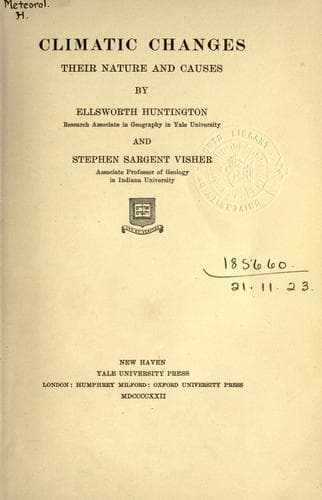
Climatic Changes: Their Nature and CausesHuntington, Ellsworth
Science
Climatic Changes: Their Nature and Causes
Huntington, Ellsworth
Climatic changes; Climatology; Paleoclimatology
There were forests in the immediate vicinity, forests producing
timbers of great length and thickness; for in the north and
northeast practically all the buildings had wooden roofs, wooden
intermediate floors, and other features of wood. Costly buildings,
such as temples and churches, employed large wooden beams; but wood
was used in much larger quantities in private dwellings, shops,
stables, and barns. If wood had not been plentiful and cheap--which
means grown near by--the builders would have adopted the building
methods of their neighbors in the south, who used very little wood
and developed the most perfect type of lithic architecture the
world has ever seen. And here there exists a strange anomaly:
Northern Syria, where so much wood was employed in antiquity, is
absolutely treeless now; while in the mountains of southern Syria,
where wood must have been scarce in antiquity to have forced upon
the inhabitants an almost exclusive use of stone, there are still
groves of scrub oak and pine, and travelers of half a century ago
reported large forests of chestnut trees.[20] It is perfectly
apparent that large parts of Syria once had soil and forests and
springs and rivers, while it has none of these now, and that it had
a much larger and better distributed rainfall in ancient times than
it has now.
Professor Butler's careful work is especially interesting because of its
contrast to the loose statements of those who believe in climatic
uniformity. So far as I am aware, no opponent of the hypothesis of
climatic changes has ever even attempted to show by careful statistical
analysis that the ancient water supply of such ruins was no greater than
that of the present. The most that has been done is to suggest that
there may have been sources of water which are now unknown. Of course,
this might be true in a single instance, but it could scarcely be the
case in many hundreds or thousands of ruins.
Although the arguments in favor of a change of climate during the last
two thousand years seem too strong to be ignored, their very strength
seems to have been a source of error. A large number of people have
jumped to the conclusion that the change which appears to have occurred
in certain regions occurred everywhere, and that it consisted of a
gradual desiccation.
Public-domain text, read in full here on John Shaqi.
Reviews
Reviews
No reviews yet
Be the first to share your thoughts on this work.
Join the Discussion
Join the discussion
Sign in to leave a comment or review.
Sign InorCreate an account