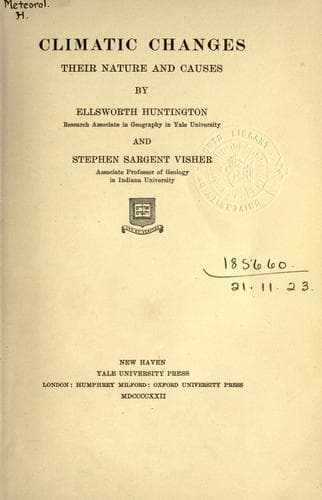
Climatic Changes: Their Nature and CausesHuntington, Ellsworth
Science
Climatic Changes: Their Nature and Causes
Huntington, Ellsworth
Climatic changes; Climatology; Paleoclimatology
The role of climate in the life of today suggests its importance in the
past and in the future. No human being can escape from the fact that his
food, clothing, shelter, recreation, occupation, health, and energy are
all profoundly influenced by his climatic surroundings. A change of
season brings in its train some alteration in practically every phase of
human activity. Animals are influenced by climate even more than man,
for they have not developed artificial means of protecting themselves.
Even so hardy a creature as the dog becomes notably different with a
change of climate. The thick-haired "husky" of the Eskimos has outwardly
little in common with the small and almost hairless canines that grovel
under foot in Mexico. Plants are even more sensitive than animals and
men. Scarcely a single species can flourish permanently in regions which
differ more than 20 deg.C. in average yearly temperature, and for most the
limit of successful growth is 10 deg..[1] So far as we yet know every living
species of plant and animal, including man, thrives best under definite
and limited conditions of temperature, humidity, and sunshine, and of
the composition and movement of the atmosphere or water in which it
lives. Any departure beyond the limits means lessened efficiency, and in
the long run a lower rate of reproduction and a tendency toward changes
in specific characteristics. Any great departure means suffering or
death for the individual and destruction for the species.
Since climate has so profound an influence on life today, it has
presumably been equally potent at other times. Therefore few scientific
questions are more important than how and why the earth's climate has
varied in the past, and what changes it is likely to undergo in the
future. This book sets forth what appear to be the chief reasons for
climatic variations during historic and geologic times. It assumes that
causes which can now be observed in operation, as explained in a
companion volume entitled _Earth and Sun_, and in such books as
Humphreys' _Physics of the Air_, should be carefully studied before less
obvious causes are appealed to. It also assumes that these same causes
will continue to operate, and are the basis of all valid predictions as
to the weather or climate of the future.
Public-domain text, read in full here on John Shaqi.
Reviews
Reviews
No reviews yet
Be the first to share your thoughts on this work.
Join the Discussion
Join the discussion
Sign in to leave a comment or review.
Sign InorCreate an account