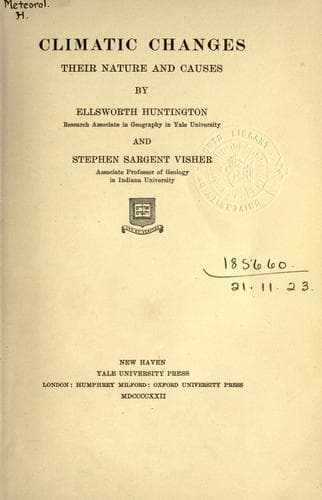
Climatic Changes: Their Nature and CausesHuntington, Ellsworth
Science
Climatic Changes: Their Nature and Causes
Huntington, Ellsworth
Climatic changes; Climatology; Paleoclimatology
In our analysis of climatic variations, we may well begin by inquiring
how the earth's climate has varied during geological history. Such an
inquiry discloses three great tendencies, which to the superficial view
seem contradictory. All, however, have a similar effect in providing
conditions under which organic evolution is able to make progress. The
first tendency is toward uniformity, a uniformity so pronounced and of
such vast duration as to stagger the imagination. Superposed upon this
there seems to be a tendency toward complexity. During the greater part
of geological history the earth's climate appears to have been
relatively monotonous, both from place to place and from season to
season; but since the Miocene the rule has been diversity and
complexity, a condition highly favorable to organic evolution. Finally,
the uniformity of the vast eons of the past and the tendency toward
complexity are broken by pulsatory changes, first in one direction and
then in another. To our limited human vision some of the changes, such
as glacial periods, seem to be waves of enormous proportions, but
compared with the possibilities of the universe they are merely as the
ripples made by a summer zephyr.
The uniformity of the earth's climate throughout the vast stretches of
geological time can best be realized by comparing the range of
temperature on the earth during that period with the possible range as
shown in the entire solar system. As may be seen in Table 1, the
geological record opens with the Archeozoic era, or "Age of Unicellular
Life," as it is sometimes called, for the preceding cosmic time has left
no record that can yet be read. Practically no geologists now believe
that the beginning of the Archeozoic was less than one hundred million
years ago; and since the discovery of the peculiar properties of radium
many of the best students do not hesitate to say a billion or a billion
and a half.[2] Even in the Archeozoic the rocks testify to a climate
seemingly not greatly different from that of the average of geologic
time. The earth's surface was then apparently cool enough so that it was
covered with oceans and warm enough so that the water teemed with
microscopic life. The air must have been charged with water vapor and
with carbon dioxide, for otherwise there seems to be no possible way of
explaining the formation of mudstones and sandstones, limestones of vast
thickness, carbonaceous shales, graphites, and iron ores.[3] Although
the Archeozoic has yielded no generally admitted fossils, yet what seem
to be massive algae and sponges have been found in Canada. On the other
hand, abundant life is believed to have been present in the oceans, for
by no other known means would it be possible to take from the air the
vast quantities of carbon that now form carbonaceous shales and
graphite.
Public-domain text, read in full here on John Shaqi.
Reviews
Reviews
No reviews yet
Be the first to share your thoughts on this work.
Join the Discussion
Join the discussion
Sign in to leave a comment or review.
Sign InorCreate an account