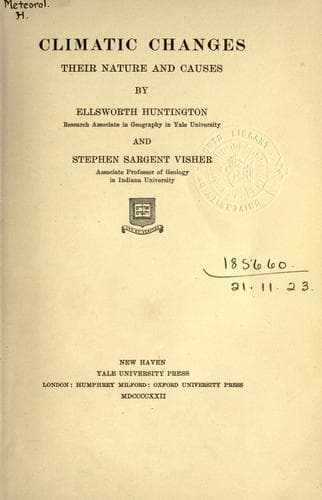
Climatic Changes: Their Nature and CausesHuntington, Ellsworth
Science
Climatic Changes: Their Nature and Causes
Huntington, Ellsworth
Climatic changes; Climatology; Paleoclimatology
In the next geologic era, the Proterozoic, the researches of Walcott
have shown that besides the marine algae there must have been many other
kinds of life. The Proterozoic fossils thus far discovered include not
only microscopic radiolarians such as still form the red ooze of the
deepest ocean floors, but the much more significant tubes of annelids or
worms. The presence of the annelids, which are relatively high in the
scale of organization, is generally taken to mean that more lowly forms
of animals such as coelenterates and probably even the mollusca and
primitive arthropods must already have been evolved. That there were
many kinds of marine invertebrates living in the later Proterozoic is
indicated by the highly varied life and more especially the trilobites
found in the oldest Cambrian strata of the next succeeding period. In
fact the Cambrian has sponges, primitive corals, a great variety of
brachiopods, the beginnings of gastropods, a wonderful array of
trilobites, and other lowly forms of arthropods. Since, under the
postulate of evolution, the life of that time forms an unbroken sequence
with that of the present, and since many of the early forms differ only
in minor details from those of today, we infer that the climate then was
not very different from that of today. The same line of reasoning leads
to the conclusion that even in the middle of the Proterozoic, when
multicellular marine animals must already have been common, the climate
of the earth had already for an enormous period been such that all the
lower types of oceanic invertebrates had already evolved.
TABLE 1
THE GEOLOGICAL TIME TABLE[4]
COSMIC TIME
FORMATIVE ERA. Birth and growth of the earth. Beginnings of the
atmosphere, hydrosphere, continental platforms, oceanic basins,
and possibly of life. No known geological record.
GEOLOGIC TIME
ARCHEOZOIC ERA. Origin of simplest life.
PROTEROZOIC ERA. Age of invertebrate origins. An early and a late
ice age, with one or more additional ones indicated.
PALEOZOIC ERA. Age of primitive vertebrate dominance.
_Cambrian Period._ First abundance of marine animals and dominance
of trilobites.
_Ordovician Period._ First known fresh-water fishes.
_Silurian Period._ First known land plants.
_Devonian Period._ First known amphibians. "Table Mountain" ice
age.
_Mississippian Period._ Rise of marine fishes (sharks).
_Pennsylvanian Period._ Rise of insects and first period of marked
coal accumulation.
_Permian Period._ Rise of reptiles. Another great ice age.
MESOZOIC ERA. Age of reptile dominance.
_Triassic Period._ Rise of dinosaurs. The period closes with a
cool climate.
_Jurassic Period._ Rise of birds and flying reptiles.
_Comanchean Period._ Rise of flowering plants and higher insects.
_Cretaceous Period._ Rise of archaic or primitive mammalia.
CENOZOIC ERA. Age of mammal dominance.
Public-domain text, read in full here on John Shaqi.
Reviews
Reviews
No reviews yet
Be the first to share your thoughts on this work.
Join the Discussion
Join the discussion
Sign in to leave a comment or review.
Sign InorCreate an account