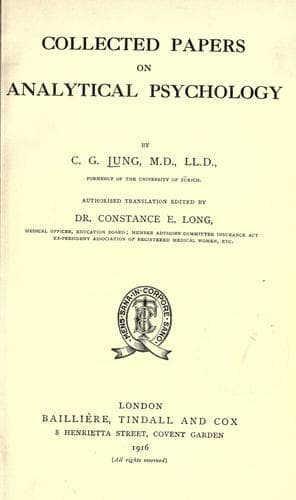
Collected Papers on Analytical PsychologyJung, C. G. (Carl Gustav)
Science
Collected Papers on Analytical Psychology
Jung, C. G. (Carl Gustav)
Psychoanalysis
When speaking of the reviews, I must also mention those that seem to
me beside the mark. I was once more struck by the fact that certain
critics cannot distinguish between the theoretical explanation given by
the author, and the phantastic ideas provided by the patient. One of
my critics makes this confusion when discussing "Number Dreams." The
associations to the quotation from the Bible in Chapter V. are, as every
attentive reader must readily perceive, not arbitrary explanations of
my own, but a cryptomnesic conglomeration emanating, not from my brain
at all, but from that of the patient. Surely it is not difficult to
perceive upon reflection that this conglomeration of numbers corresponds
exactly to that unconscious psychological function from which proceeded
all the mysticism of numbers, Pythagoric, Kabbalistic, and so forth,
existent from untold ages.
I am grateful to my serious reviewers, and should like here to also
express my thanks to Mrs. Harold F. McCormick for her generous help in
the production of this book.
C. G. JUNG.
_June, 1917._
AUTHOR'S PREFACE TO FIRST EDITION
This volume contains a selection of articles and pamphlets on analytical
psychology written at intervals during the past fourteen years. These
years have seen the development of a new discipline, and as is usual in
such a case, have involved many changes of view-point, of concept, and
of formulation.
It is not my intention to give a presentation of the fundamental
concepts of analytical psychology in this book; it throws some
light, however, on a certain line of development which is especially
characteristic of the Zürich School of psychoanalysis.
As is well known, the merit of the discovery of the new analytical
method of general psychology belongs to Professor Freud of Vienna. His
original view-points had to undergo many essential modifications, some
of them owing to the work done at Zürich, in spite of the fact that he
himself is far from agreeing with the standpoint of this school.
I am unable to explain fully the fundamental differences between the
two schools, but would indicate the following points: The Vienna School
takes the standpoint of an exclusive sexualistic conception, while
that of the Zürich School is symbolistic. The Vienna School interprets
the psychological symbol semiotically, as a sign or token of certain
primitive psychosexual processes. Its method is analytical and causal.
The Zürich School recognises the scientific feasibility of such a
conception, but denies its exclusive validity, for it does not interpret
the psychological symbol semiotically only, but also symbolistically,
that is, it attributes a positive value to the symbol.
Public-domain text, read in full here on John Shaqi.
Reviews
Reviews
No reviews yet
Be the first to share your thoughts on this work.
Join the Discussion
Join the discussion
Sign in to leave a comment or review.
Sign InorCreate an account