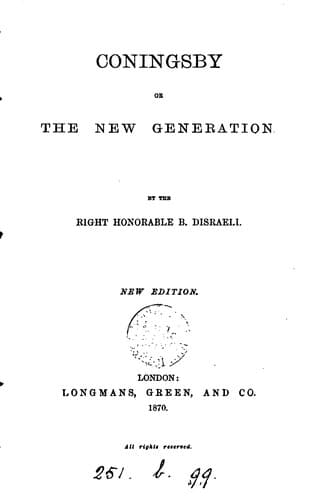
Coningsby; Or, The New GenerationDisraeli, Benjamin, Earl of Beaconsfield
General
Coningsby; Or, The New Generation
Disraeli, Benjamin, Earl of Beaconsfield
Great Britain -- Fiction; Political fiction; Politicians -- Fiction
His widow returned to England with her child; and, not having a
relation, and scarcely an acquaintance in the world, made an appeal to
her husband’s father, the wealthiest noble in England and a man who was
often prodigal, and occasionally generous. After some time, and
more trouble, after urgent and repeated, and what would have seemed
heart-rending, solicitations, the attorney of Lord Monmouth called
upon the widow of his client’s son, and informed her of his Lordship’s
decision. Provided she gave up her child, and permanently resided in
one of the remotest counties, he was authorised to make her, in four
quarterly payments, the yearly allowance of three hundred pounds, that
being the income that Lord Monmouth, who was the shrewdest accountant in
the country, had calculated a lone woman might very decently exist upon
in a small market town in the county of Westmoreland.
Desperate necessity, the sense of her own forlornness, the utter
impossibility to struggle with an omnipotent foe, who, her husband had
taught her, was above all scruples, prejudices, and fears, and who,
though he respected law, despised opinion, made the victim yield. But
her sufferings were not long; the separation from her child, the bleak
clime, the strange faces around her, sharp memory, and the dull routine
of an unimpassioned life, all combined to wear out a constitution
originally frail, and since shattered by many sorrows. Mrs. Coningsby
died the same day that her father-in-law was made a Marquess. He
deserved his honours. The four votes he had inherited in the House of
Commons had been increased, by his intense volition and unsparing means,
to ten; and the very day he was raised to his Marquisate, he commenced
sapping fresh corporations, and was working for the strawberry leaf. His
honours were proclaimed in the London Gazette, and her decease was not
even noticed in the County Chronicle; but the altars of Nemesis are
beneath every outraged roof, and the death of this unhappy lady,
apparently without an earthly friend or an earthly hope, desolate and
deserted, and dying in obscure poverty, was not forgotten.
Public-domain text, read in full here on John Shaqi.
Reviews
Reviews
No reviews yet
Be the first to share your thoughts on this work.
Join the Discussion
Join the discussion
Sign in to leave a comment or review.
Sign InorCreate an account