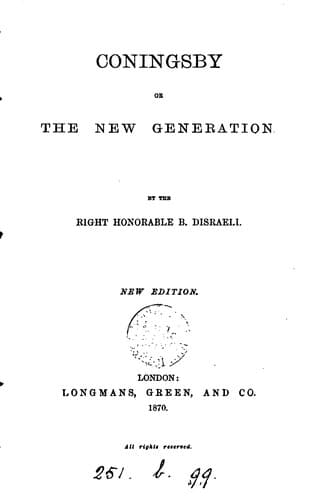
Coningsby; Or, The New GenerationDisraeli, Benjamin, Earl of Beaconsfield
General
Coningsby; Or, The New Generation
Disraeli, Benjamin, Earl of Beaconsfield
Great Britain -- Fiction; Political fiction; Politicians -- Fiction
It did not subsequently appear that the Reform ministers had been
invested with any such power; but a conviction of the reverse, fostered
by these circumstances, had successfully acted upon the nervous
temperament, or the statesman-like prudence, of a certain section of the
peers, who consequently hesitated in their course; were known as being
no longer inclined to pursue their policy of the preceding session; had
thus obtained a title at that moment in everybody’s mouth, the title of
‘THE WAVERERS.’
Notwithstanding, therefore, the opposition of the Duke of Wellington and
of Lord Lyndhurst, the Waverers carried the second reading of the Reform
Bill; and then, scared at the consequences of their own headstrong
timidity, they went in a fright to the Duke and his able adviser to
extricate them from the inevitable result of their own conduct.
The ultimate device of these distracted counsels, where daring and
poltroonery, principle and expediency, public spirit and private
intrigue, each threw an ingredient into the turbulent spell, was the
celebrated and successful amendment to which we have referred.
But the Whig ministers, who, whatever may have been their faults, were
at least men of intellect and courage, were not to be beaten by ‘the
Waverers.’ They might have made terms with an audacious foe; they
trampled on a hesitating opponent. Lord Grey hastened to the palace.
Before the result of this appeal to the Sovereign was known, for its
effects were not immediate, on the second morning after the vote in the
House of Lords, Mr. Rigby had made that visit to Eton which had summoned
very unexpectedly the youthful Coningsby to London. He was the orphan
child of the youngest of the two sons of the Marquess of Monmouth. It
was a family famous for its hatreds. The eldest son hated his father;
and, it was said, in spite had married a lady to whom that father was
attached, and with whom Lord Monmouth then meditated a second alliance.
This eldest son lived at Naples, and had several children, but
maintained no connection either with his parent or his native country.
On the other hand, Lord Monmouth hated his younger son, who had married,
against his consent, a woman to whom that son was devoted. A system of
domestic persecution, sustained by the hand of a master, had eventually
broken up the health of its victim, who died of a fever in a foreign
country, where he had sought some refuge from his creditors.
Public-domain text, read in full here on John Shaqi.
Reviews
Reviews
No reviews yet
Be the first to share your thoughts on this work.
Join the Discussion
Join the discussion
Sign in to leave a comment or review.
Sign InorCreate an account