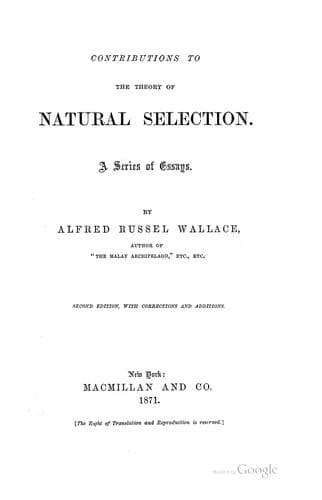
Contributions to the Theory of Natural Selection: A Series of Essays — John Shaqi
Contributions to the Theory of Natural Selection: A Series of EssaysWallace, Alfred Russel
Science
Contributions to the Theory of Natural Selection: A Series of Essays
Wallace, Alfred Russel
Natural selection
The conformity of tint which has been so far shown to exist between
animals and their habitations is of a somewhat general character; we
will now consider the cases of more special adaptation. If the lion is
enabled by his sandy colour readily to conceal himself by merely
crouching down upon the desert, how, it may be asked, do the elegant
markings of the tiger, the jaguar, and the other large cats agree with
this theory? We reply that these are generally cases of more or less
special adaptation. The tiger is a jungle animal, and hides himself
among tufts of grass or of bamboos, and in these positions the vertical
stripes with which his body is adorned must so assimilate with the
vertical stems of the bamboo, as to assist greatly in concealing him
from his approaching prey. How remarkable it is that besides the lion
and tiger, almost all the other large cats are arboreal in their
habits, and almost all have ocellated or spotted skins, which must
certainly tend to blend them with the background of foliage; while the
one exception, the puma, has an ashy brown uniform fur, and has the
habit of clinging so closely to a limb of a tree while waiting for his
prey to pass beneath as to be hardly distinguishable from the bark.
Among birds, the ptarmigan, already mentioned, must be considered a
remarkable case of special adaptation. Another is a South-American
goatsucker (Caprimulgus rupestris) which rests in the bright sunshine on
little bare rocky islets in the Upper Rio Negro, where its unusually
light colours so closely resemble those of the rock and sand, that it
can scarcely be detected till trodden upon.
The Duke of Argyll, in his "Reign of Law," has pointed out the admirable
adaptation of the colours of the woodcock to its protection. The various
browns and yellows and pale ash-colour that occur in fallen leaves are
all reproduced in its plumage, so that when according to its habit it
rests upon the ground under trees, it is almost impossible to detect it.
In snipes the colours are modified so as to be equally in harmony with
the prevalent forms and colours of marshy vegetation. Mr. J. M. Lester,
in a paper read before the Rugby School Natural History Society,
observes:--"The wood-dove, when perched amongst the branches of its
favourite _fir_, is scarcely discernible; whereas, were it among some
lighter foliage, the blue and purple tints in its plumage would far
sooner betray it. The robin redbreast too, although it might be thought
that the red on its breast made it much easier to be seen, is in reality
not at all endangered by it, since it generally contrives to get among
some russet or yellow fading leaves, where the red matches very well
with the autumn tints, and the brown of the rest of the body with the
bare branches."
Public-domain text, read in full here on John Shaqi.
Reviews
Reviews
No reviews yet
Be the first to share your thoughts on this work.
Join the Discussion
Join the discussion
Sign in to leave a comment or review.
Sign InorCreate an account