Contributions to the Theory of Natural Selection: A Series of Essays — John Shaqi
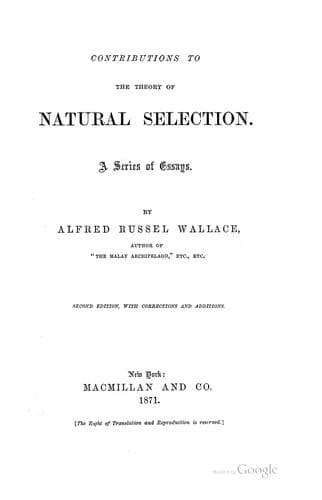
Contributions to the Theory of Natural Selection: A Series of EssaysWallace, Alfred Russel
Science
Contributions to the Theory of Natural Selection: A Series of Essays
Wallace, Alfred Russel
Natural selection
Reptiles offer us many similar examples. The most arboreal lizards, the
iguanas, are as green as the leaves they feed upon, and the slender
whip-snakes are rendered almost invisible as they glide among the
foliage by a similar colouration. How difficult it is sometimes to catch
sight of the little green tree-frogs sitting on the leaves of a small
plant enclosed in a glass case in the Zoological Gardens; yet how much
better concealed must they be among the fresh green damp foliage of a
marshy forest. There is a North-American frog found on lichen-covered
rocks and walls, which is so coloured as exactly to resemble them, and
as long as it remains quiet would certainly escape detection. Some of
the geckos which cling motionless on the trunks of trees in the tropics,
are of such curiously marbled colours as to match exactly with the bark
they rest upon.
In every part of the tropics there are tree-snakes that twist among
boughs and shrubs, or lie coiled up on the dense masses of foliage.
These are of many distinct groups, and comprise both venomous and
harmless genera; but almost all of them are of a beautiful green
colour, sometimes more or less adorned with white or dusky bands and
spots. There can be little doubt that this colour is doubly useful to
them, since it will tend to conceal them from their enemies, and will
lead their prey to approach them unconscious of danger. Dr. Gunther
informs me that there is only one genus of true arboreal snakes (Dipsas)
whose colours are rarely green, but are of various shades of black,
brown, and olive, and these are all nocturnal reptiles, and there can be
little doubt conceal themselves during the day in holes, so that the
green protective tint would be useless to them, and they accordingly
retain the more usual reptilian hues.
Fishes present similar instances. Many flat fish, as for example the
flounder and the skate, are exactly the colour of the gravel or sand on
which they habitually rest. Among the marine flower gardens of an
Eastern coral reef the fishes present every variety of gorgeous colour,
while the river fish even of the tropics rarely if ever have gay or
conspicuous markings. A very curious case of this kind of adaptation
occurs in the sea-horses (Hippocampus) of Australia, some of which bear
long foliaceous appendages resembling seaweed, and are of a brilliant
red colour; and they are known to live among seaweed of the same hue, so
that when at rest they must be quite invisible. There are now in the
aquarium of the Zoological Society some slender green pipe-fish which
fasten themselves to any object at the bottom by their prehensile
tails, and float about with the current, looking exactly like some
simple cylindrical algae.
Public-domain text, read in full here on John Shaqi.
Reviews
Reviews
No reviews yet
Be the first to share your thoughts on this work.
Join the Discussion
Join the discussion
Sign in to leave a comment or review.
Sign InorCreate an account