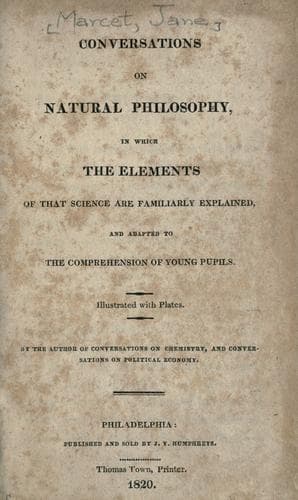
Conversations on Natural Philosophy, in which the Elements of that Science are Familiarly ExplainedMarcet, Mrs. (Jane Haldimand)
Science
Conversations on Natural Philosophy, in which the Elements of that Science are Familiarly Explained
Marcet, Mrs. (Jane Haldimand)
Physics
The next essential property of matter is called _inertia_ or inactivity;
this word expresses the resistance which matter makes to a change from a
state of rest, to that of motion, or from a state of motion to that of
rest. Bodies are equally incapable of changing their actual state,
whether it be of motion or of rest. You know that it requires force to
put a body which is at rest in motion; an exertion of strength is also
requisite to stop a body which is already in motion. The resistance of
the body to a change of state, in either case, arises from its
_inertia_.
_Emily._ In playing at base-ball I am obliged to use all my strength to
give a rapid motion to the ball; and when I have to catch it, I am sure
I feel the resistance it makes to being stopped. But if I did not catch
it, it would soon fall to the ground and stop of itself.
_Mrs. B._ Matter being inert it is as incapable of stopping of itself as
it is of putting itself into motion: when the ball ceases to move,
therefore, it must be stopped by some other cause or power; but as it is
one with which you are yet unacquainted, we can not at present
investigate its effects.
The last property which appears to be common to all bodies is
_attraction_. All bodies consist of infinitely small particles of
matter, each of which possesses the power of attracting or drawing
towards it, and uniting with any other particle sufficiently near to be
within the influence of its attraction; but in minute particles this
power extends to so very small a distance around them, that its effect
is not sensible, unless they are (or at least appear to be) in contact;
it then makes them stick or adhere together, and is hence called the
_attraction of cohesion_. Without this power, solid bodies would fall in
pieces, or rather crumble to atoms.
_Emily._ I am so much accustomed to see bodies firm and solid, that it
never occurred to me that any power was requisite to unite the particles
of which they are composed. But the attraction of cohesion does not, I
suppose, exist in liquids; for the particles of liquids do not remain
together so as to form a body, unless confined in a vessel?
_Mrs. B._ I beg your pardon; it is the attraction of cohesion which
holds this drop of water suspended at the end of my finger, and keeps
the minute watery particles of which it is composed united. But as this
power is stronger in proportion as the particles of bodies are more
closely united, the cohesive attraction of solid bodies is much greater
than that of fluids.
The thinner and lighter a fluid is, the less is the cohesive attraction
of its particles, because they are further apart; and in elastic fluids,
such as air, there is no cohesive attraction among the particles.
_Emily._ That is very fortunate; for it would be impossible to breathe
the air in a solid mass; or even in a liquid state.
But is the air a body of the same nature as other bodies?
_Mrs. B._ Undoubtedly, in all essential properties.
Public-domain text, read in full here on John Shaqi.
Reviews
Reviews
No reviews yet
Be the first to share your thoughts on this work.
Join the Discussion
Join the discussion
Sign in to leave a comment or review.
Sign InorCreate an account