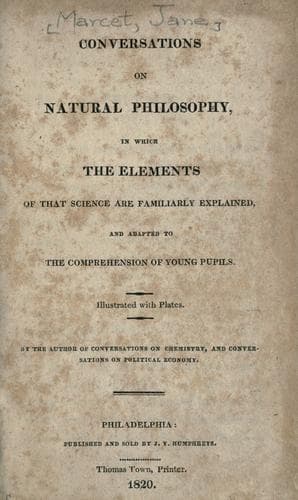
Conversations on Natural Philosophy, in which the Elements of that Science are Familiarly ExplainedMarcet, Mrs. (Jane Haldimand)
Science
Conversations on Natural Philosophy, in which the Elements of that Science are Familiarly Explained
Marcet, Mrs. (Jane Haldimand)
Physics
_Emily._ That is wonderful indeed; the particles then, which exhale from
the flower and from the lavender water, are, I suppose, too small to be
visible?
_Mrs. B._ Certainly: you may form some idea of their extreme minuteness,
from the immense number which must have escaped in order to perfume the
whole room; and yet there is no sensible diminution of the liquid in the
phial.
_Emily._ But the quantity must really be diminished?
_Mrs. B._ Undoubtedly; and were you to leave the bottle open a
sufficient length of time, the whole of the water would evaporate and
disappear. But though so minutely subdivided as to be imperceptible to
any of our senses, each particle would continue to exist; for it is not
within the power of man to destroy a single particle of matter: nor is
there any reason to suppose that in nature an atom is ever annihilated.
_Emily._ Yet, when a body is burnt to ashes, part of it, at least,
appears to be effectually destroyed: look how small is the residue of
ashes in the fire place, from all the fuel which has been consumed
within it.
_Mrs. B._ That part of the fuel, which you suppose to be destroyed,
evaporates in the form of smoke, and vapour, and air, whilst the
remainder is reduced to ashes. A body, in burning, undergoes no doubt
very remarkable changes; it is generally subdivided; its form and colour
altered; its extension increased: but the various parts, into which it
has been separated by combustion, continue in existence, and retain all
the essential properties of bodies.
_Emily._ But that part of a burnt body which evaporates in smoke has no
figure; smoke, it is true, ascends in columns into the air, but it is
soon so much diffused as to lose all form; it becomes indeed invisible.
_Mrs. B._ Invisible, I allow; but we must not imagine that what we no
longer see no longer exists. Were every particle of matter that becomes
invisible annihilated, the world itself would in the course of time be
destroyed. The particles of smoke, when diffused in the air, continue
still to be particles of matter as well as when more closely united in
the form of coals: they are really as substantial in the one state as in
the other, and equally so when by their extreme subdivision they become
invisible. No particle of matter is ever destroyed: this is a principle
you must constantly remember. Every thing in nature decays and corrupts
in the lapse of time. We die, and our bodies moulder to dust; but not a
single atom of them is lost; they serve to nourish the earth, whence,
while living, they drew their support.
Public-domain text, read in full here on John Shaqi.
Reviews
Reviews
No reviews yet
Be the first to share your thoughts on this work.
Join the Discussion
Join the discussion
Sign in to leave a comment or review.
Sign InorCreate an account