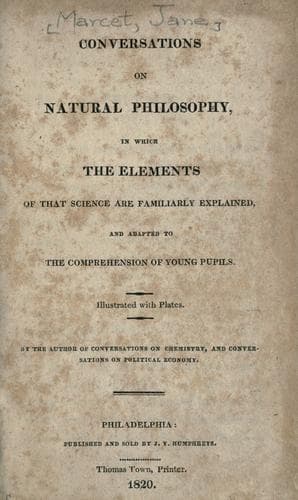
Conversations on Natural Philosophy, in which the Elements of that Science are Familiarly ExplainedMarcet, Mrs. (Jane Haldimand)
Science
Conversations on Natural Philosophy, in which the Elements of that Science are Familiarly Explained
Marcet, Mrs. (Jane Haldimand)
Physics
_Emily._ Yet you say that it does not possess one of the general
properties of bodies--attraction.
_Mrs. B._ The particles of air are not destitute of the power of
attraction, but they are too far distant from each other to be
influenced by it so as to produce cohesion: and the utmost efforts of
human art have proved ineffectual in the attempt to compress them, so as
to bring them within the sphere of each other's attraction, and make
them cohere.
_Emily._ If so, how is it possible to prove that they are endowed with
this power?
_Mrs. B._ The air is formed of particles precisely of the same nature as
those which enter into the composition of liquid and solid bodies, in
each of which we have a proof of their attraction.
_Emily._ It is then, I suppose, owing to the different degrees of
cohesive attraction in different substances, that they are hard or soft,
and that liquids are thick or thin.
_Mrs. B._ Yes; but you would express your meaning better by the term
_density_, which denotes the degree of closeness and compactness of the
particles of a body. In philosophical language, density is said to be
that property of bodies by which they contain a certain quantity of
matter, under a certain bulk or magnitude. _Rarity_ is the contrary of
density; it denotes the thinness and subtilty of bodies: thus you would
say that mercury or quicksilver was a very dense fluid; ether, a very
rare one. Those bodies which are the most dense, do not always cohere
the most strongly; lead is more dense than iron, yet its particles are
more easily separated.
_Caroline._ But how are we to judge of the quantity of matter contained
in a certain bulk?
_Mrs. B._ By the weight: under the same bulk bodies are said to be dense
in proportion as they are heavy.
_Emily._ Then we may say that metals are dense bodies, wood
comparatively a rare one, &c. But, Mrs. B., when the particles of a body
are so near as to attract each other, the effect of this power must
increase as they are brought by it closer together; so that one would
suppose that the body would gradually augment in density, till it was
impossible for its particles to be more closely united. Now, we know
that this is not the case; for soft bodies, such as cork, sponge, or
butter, never become, in consequence of the increasing attraction of
their particles, as hard as iron?
_Mrs. B._ In such bodies as cork and sponge, the particles which come in
contact are so few as to produce but a slight degree of cohesion: they
are porous bodies, which, owing to the peculiar arrangement of their
particles, abound with interstices, or pores, which separate the
particles. But there is also a fluid much more subtile than air, which
pervades all bodies, this is _heat_. Heat insinuates itself more or less
between the particles of all bodies, and forces them asunder; you may
therefore consider heat, and the attraction of cohesion, as constantly
acting in opposition to each other.
Public-domain text, read in full here on John Shaqi.
Reviews
Reviews
No reviews yet
Be the first to share your thoughts on this work.
Join the Discussion
Join the discussion
Sign in to leave a comment or review.
Sign InorCreate an account