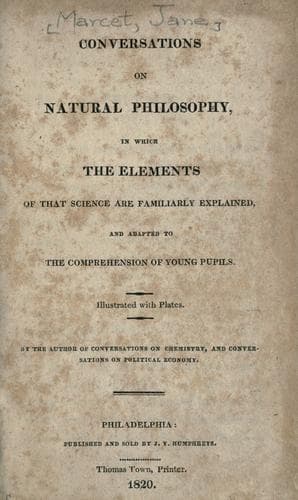
Conversations on Natural Philosophy, in which the Elements of that Science are Familiarly Explained — John Shaqi
Conversations on Natural Philosophy, in which the Elements of that Science are Familiarly ExplainedMarcet, Mrs. (Jane Haldimand)
Science
Conversations on Natural Philosophy, in which the Elements of that Science are Familiarly Explained
Marcet, Mrs. (Jane Haldimand)
Physics
_Emily._ The one endeavouring to rend a body to pieces, the other to
keep its parts firmly united.
_Mrs. B._ And it is this struggle between the contending forces of heat
and attraction, which prevents the extreme degree of density which would
result from the sole influence of the attraction of cohesion.
_Emily._ The more a body is heated then, the more its particles will be
separated.
_Mrs. B._ Certainly: we find that bodies not only swell or dilate, but
lose their cohesion, by heat: this effect is very sensible in butter,
for instance, which expands by the application of heat, till at length
the attraction of cohesion is so far diminished that the particles
separate, and the butter becomes liquid. A similar effect is produced by
heat on metals, and all bodies susceptible of being melted. Liquids, you
know, are made to boil by the application of heat; the attraction of
cohesion then yields entirely to the repulsive power; the particles are
totally separated and converted into steam or vapour. But the agency of
heat is in no body more sensible than in air, which dilates and
contracts by its increase or diminution in a very remarkable degree.
_Emily._ The effects of heat appear to be one of the most interesting
parts of natural philosophy.
_Mrs. B._ That is true; but heat is so intimately connected with
chemistry, that you must allow me to defer the investigation of its
properties till you become acquainted with that science.
To return to its antagonist, the attraction of cohesion; it is this
power which restores to vapour its liquid form, which unites it into
drops when it falls to earth in a shower of rain, which gathers the dew
into brilliant gems on the blades of grass.
_Emily._ And I have often observed that after a shower, the water
collects into large drops on the leaves of plants; but I cannot say that
I perfectly understand how the attraction of cohesion produces this
effect.
_Mrs. B._ Rain, when it first leaves the clouds, is not in the form of
drops, but in that of mist or vapour, which is composed of very small
watery particles; these in their descent mutually attract each other,
and those that are sufficiently near in consequence unite and form a
drop, and thus the mist is transformed into a shower. The dew also was
originally in a state of vapour, but is, by the mutual attraction of the
particles, formed into small globules on the blades of grass: in a
similar manner the rain upon the leaf collects into large drops, which
when they become too heavy for the leaf to support, fall to the ground.
_Emily._ All this is wonderfully curious! I am almost bewildered with
surprise and admiration at the number of new ideas I have already
acquired.
Public-domain text, read in full here on John Shaqi.
Reviews
Reviews
No reviews yet
Be the first to share your thoughts on this work.
Join the Discussion
Join the discussion
Sign in to leave a comment or review.
Sign InorCreate an account