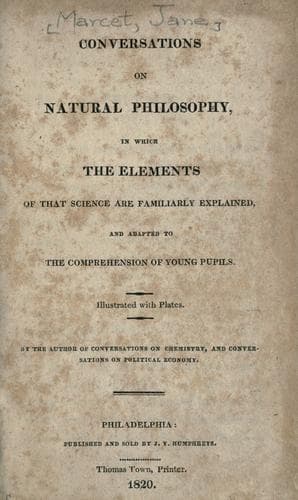
Conversations on Natural Philosophy, in which the Elements of that Science are Familiarly ExplainedMarcet, Mrs. (Jane Haldimand)
Science
Conversations on Natural Philosophy, in which the Elements of that Science are Familiarly Explained
Marcet, Mrs. (Jane Haldimand)
Physics
_Mrs. B._ Every step that you advance in the pursuit of natural science,
will fill your mind with admiration and gratitude towards its Divine
Author. In the study of natural philosophy, we must consider ourselves
as reading the book of nature, in which the bountiful goodness and
wisdom of God are revealed to all mankind; no study can tend more to
purify the heart, and raise it to a religious contemplation of the
Divine perfections.
There is another curious effect of the attraction of cohesion which I
must point out to you; this is called capillary attraction. It enables
liquids to rise above their ordinary level in capillary tubes: these are
tubes, the bores of which are so extremely small that liquids ascend
within them, from the cohesive attraction between the particles of the
liquid and the interior surface of the tube. Do you perceive the water
rising in this small glass tube, above its level in the goblet of water,
into which I have put one end of it?
_Emily._ Oh yes; I see it slowly creeping up the tube, but now it is
stationary: will it rise no higher?
_Mrs. B._ No; because the cohesive attraction between the water and the
internal surface of the tube is now balanced by the weight of the water
within it; if the bore of the tube were narrower the water would rise
higher; and if you immerse several tubes of bores of different sizes,
you will see it rise to different heights in each of them. In making
this experiment, you should colour the water with a little red wine, in
order to render the effect more obvious.
All porous substances, such as sponge, bread, linen, &c. may be
considered as collections of capillary tubes: if you dip one end of a
lump of sugar into water, the fluid will rise in it, and wet it
considerably above the surface of the water into which you dip it.
_Emily._ In making tea I have often observed that effect, without being
able to account for it.
_Mrs. B._ Now that you are acquainted with the attraction of cohesion, I
must endeavour to explain to you that of _Gravitation_, which is
probably a modification of the same power; the first is perceptible only
in very minute particles, and at very small distances; the other acts on
the largest bodies, and extends to immense distances.
_Emily._ You astonish me: surely you do not mean to say that large
bodies attract each other?
_Mrs. B._ Indeed I do: let us take, for example, one of the largest
bodies in nature, and observe whether it does not attract other bodies.
What is it that occasions the fall of this book, when I no longer
support it?
_Emily._ Can it be the attraction of the earth? I thought that all
bodies had a natural tendency to fall.
_Mrs. B._ They have a natural tendency to fall, it is true; but that
tendency is produced entirely by the attraction of the earth: the earth
being so much larger than any body on its surface, forces every body,
which is not supported, to fall upon it.
Public-domain text, read in full here on John Shaqi.
Reviews
Reviews
No reviews yet
Be the first to share your thoughts on this work.
Join the Discussion
Join the discussion
Sign in to leave a comment or review.
Sign InorCreate an account