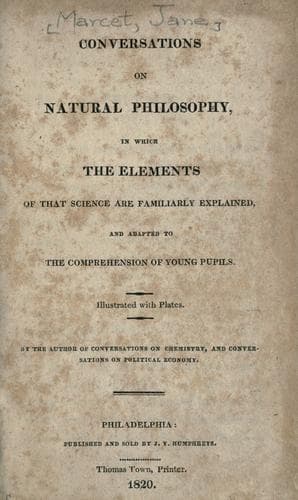
Conversations on Natural Philosophy, in which the Elements of that Science are Familiarly ExplainedMarcet, Mrs. (Jane Haldimand)
Science
Conversations on Natural Philosophy, in which the Elements of that Science are Familiarly Explained
Marcet, Mrs. (Jane Haldimand)
Physics
_Emily._ If the tendency which bodies have to fall results from the
earth's attractive power, the earth itself can have no such tendency,
since it cannot attract itself, and therefore it requires no support to
prevent it from falling. Yet the idea that bodies do not fall of their
own accord, but that they are drawn towards the earth by its attraction,
is so new and strange to me, that I know not how to reconcile myself to
it.
_Mrs. B._ When you are accustomed to consider the fall of bodies as
depending on this cause, it will appear to you as natural, and surely
much more satisfactory, than if the cause of their tendency to fall were
totally unknown. Thus you understand that all matter is attractive, from
the smallest particle to the largest mass; and that bodies attract each
other with a force proportional to the quantity of matter they contain.
_Emily._ I do not perceive any difference between the attraction of
cohesion and that of gravitation; is it not because every particle of
matter is endowed with an attractive power, that large bodies consisting
of a great number of particles, are so strongly attractive?
_Mrs. B._ True. There is, however, this difference between the
attraction of particles and that of masses, that the former takes place
only when the particles are contiguous, whilst the latter is exerted
when the masses are far from each other. The attraction of particles
frequently counteracts the attraction of gravitation. Of this you have
an instance in the attraction of capillary tubes, in which liquids
ascend by the attraction of cohesion, in opposition to that of gravity.
It is on this account that it is necessary that the bore of the tube
should be extremely small; for if the column of water within the tube is
not very minute, the attraction of cohesion would not be able either to
raise or support it in opposition to its gravity; because the increase
of weight, in a column of water of a given height, is much greater than
the increase in the attracting surface of the tube, when its size is
increased.
You may observe also, that all solid bodies are enabled by the force of
the cohesive attraction of their particles to resist that of gravity,
which would otherwise disunite them, and bring them to a level with the
ground, as it does in the case of a liquid, the cohesive attraction of
which is not sufficient to enable it to resist the power of gravity.
_Emily._ And some solid bodies appear to be of this nature, as sand, and
powder for instance: there is no attraction of cohesion between their
particles?
_Mrs. B._ Every grain of powder, or sand, is composed of a great number
of other more minute particles, firmly united by the attraction of
cohesion; but amongst the separate grains there is no sensible
attraction, because they are not in sufficiently close contact.
_Emily._ Yet they actually touch each other?
Public-domain text, read in full here on John Shaqi.
Reviews
Reviews
No reviews yet
Be the first to share your thoughts on this work.
Join the Discussion
Join the discussion
Sign in to leave a comment or review.
Sign InorCreate an account