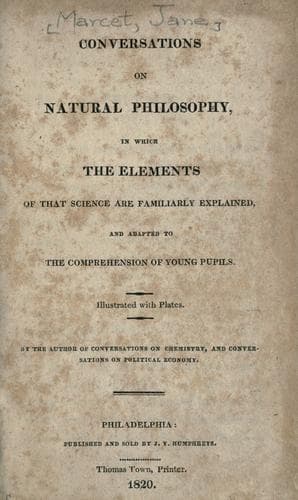
Conversations on Natural Philosophy, in which the Elements of that Science are Familiarly ExplainedMarcet, Mrs. (Jane Haldimand)
Science
Conversations on Natural Philosophy, in which the Elements of that Science are Familiarly Explained
Marcet, Mrs. (Jane Haldimand)
Physics
_Mrs. B._ The surface of bodies is in general so rough and uneven, that
when in apparent contact, they touch each other only by a few points.
Thus, when I lay this book upon the table, the binding of which appears
perfectly smooth, so few of the particles of its under surface come in
contact with the table, that no sensible degree of cohesive attraction
takes place; for you see that it does not stick or cohere to the table,
and I find no difficulty in lifting it off.
It is only when surfaces, perfectly flat and well polished, are placed
in contact, that the particles approach in sufficient number, and
closely enough, to produce a sensible degree of cohesive attraction.
Here are two plates of polished metal, I press their flat surfaces
together, having previously interposed a few drops of oil, to fill up
every little porous vacancy. Now try to separate them.
_Emily._ It requires an effort beyond my strength, though there are
handles for the purpose of pulling them asunder. Is the firm adhesion of
the two plates merely owing to the attraction of cohesion?
_Mrs. B._ There is no force more powerful, since it is by this that the
particles of the hardest bodies are held together. It would require a
weight of several pounds to separate these plates. In the present
example, however, much of the cohesive force is due to the attraction
subsisting between the metal and the oil which is interposed; as without
this, or some other fluid, the points of contact would still be
comparatively few, although we may have employed our utmost art, in
giving flat surfaces to the plates.
_Emily._ In making a kaleidoscope, I recollect that the two plates of
glass, which were to serve as mirrors, stuck so fast together, that I
imagined some of the gum I had been using had by chance been interposed
between them; but I am now convinced that it was their own natural
cohesive attraction which produced this effect.
_Mrs. B._ Very probably it was so; for plate-glass has an extremely
smooth, flat surface, admitting of the contact of a great number of
particles, when two plates are laid upon each other.
_Emily._ But, Mrs. B., the cohesive attraction of some substances is
much greater than that of others; thus glue, gum and paste, cohere with
singular tenacity.
_Mrs. B._ Bodies which differ in their natures in other respects, differ
also in their cohesive attraction; it is probable that there are no two
bodies, the particles of which attract each other with precisely the
same force.
There are some other modifications of attraction peculiar to certain
bodies; namely, that of magnetism, of electricity, and of affinity, or
chemical attraction; but we shall confine our attention merely to the
attraction of cohesion and of gravity; the examination of the latter we
shall resume at our next meeting.
Questions
1. (Pg. 10) What is intended by the term _bodies_?
2. (Pg. 10) Is the term _matter_, restricted to substances of a
particular kind?
Public-domain text, read in full here on John Shaqi.
Reviews
Reviews
No reviews yet
Be the first to share your thoughts on this work.
Join the Discussion
Join the discussion
Sign in to leave a comment or review.
Sign InorCreate an account