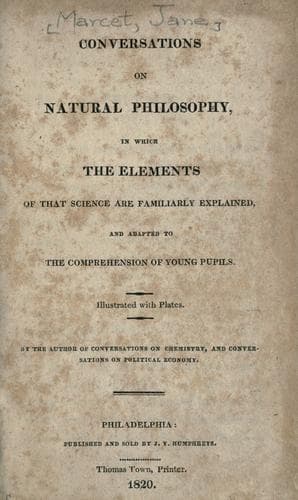
Conversations on Natural Philosophy, in which the Elements of that Science are Familiarly ExplainedMarcet, Mrs. (Jane Haldimand)
Science
Conversations on Natural Philosophy, in which the Elements of that Science are Familiarly Explained
Marcet, Mrs. (Jane Haldimand)
Physics
_Mrs. B._ You must consider, that if heavy bodies are attracted more
strongly than light ones, they require more attraction to make them
fall. Remember that bodies have no natural tendency to fall, any more
than to rise, or to move laterally, and that they will not fall unless
impelled by some force; now this force must be proportioned to the
quantity of matter it has to move: a body consisting of 1000 particles
of matter, for instance, requires ten times as much attraction to bring
it to the ground in the same space of time as a body consisting of only
100 particles.
[Illustration: PLATE I.]
_Caroline._ I do not understand that; for it seems to me, that the
heavier a body is, the move easily and readily it falls.
_Emily._ I think I now comprehend it; let me try if I can explain it to
Caroline. Suppose that I draw towards me two weighty bodies, the one of
100 lbs. the other of 1000 lbs. must I not exert ten times as much
strength to draw the larger one to me, in the same space of time, as is
required for the smaller one? And if the earth draws a body of 1000 lbs.
weight to it in the same space of time that it draws a body of 100 lbs.
does it not follow that it attracts the body of 1000 lbs. weight with
ten times the force that it does that of 100 lbs.?
_Caroline._ I comprehend your reasoning perfectly; but if it were so,
the body of 1000 lbs. weight, and that of 100 lbs. would fall with the
same rapidity; and the consequence would be, that all bodies, whether
light or heavy, being at an equal distance from the ground, would fall
to it in the same space of time: now it is very evident that this
conclusion is absurd; experience every instant contradicts it; observe
how much sooner this book reaches the floor than this sheet of paper,
when I let them drop together.
_Emily._ That is an objection I cannot answer. I must refer it to you,
Mrs. B.
_Mrs. B._ I trust that we shall not find it insurmountable. It is true
that, according to the laws of attraction, all bodies at an equal
distance from the earth, should fall to it in the same space of time;
and this would actually take place if no obstacle intervened to impede
their fall. But bodies fall through the air, and it is the resistance of
the air which makes bodies of different density fall with different
degrees of velocity. They must all force their way through the air, but
dense heavy bodies overcome this obstacle more easily than rarer or
lighter ones; because in the same space they contain more gravitating
particles.
The resistance which the air opposes to the fall of bodies is
proportioned to their surface, not to their weight; the air being inert,
cannot exert a greater force to support the weight of a cannon ball,
than it does to support the weight of a ball (of the same size) made of
leather; but the cannon ball will overcome this resistance more easily,
and fall to the ground, consequently, quicker than the leather ball.
Public-domain text, read in full here on John Shaqi.
Reviews
Reviews
No reviews yet
Be the first to share your thoughts on this work.
Join the Discussion
Join the discussion
Sign in to leave a comment or review.
Sign InorCreate an account