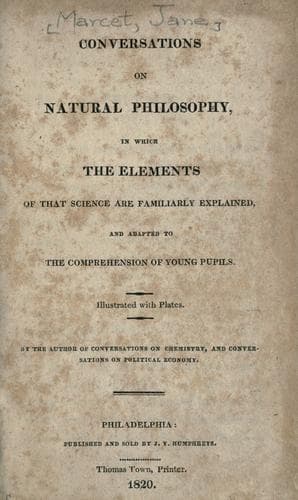
Conversations on Natural Philosophy, in which the Elements of that Science are Familiarly ExplainedMarcet, Mrs. (Jane Haldimand)
Science
Conversations on Natural Philosophy, in which the Elements of that Science are Familiarly Explained
Marcet, Mrs. (Jane Haldimand)
Physics
_Caroline._ This is very clear and solves the difficulty perfectly. The
air offers the same resistance to a bit of lead and a bit of feather of
the same size; yet the one seems to meet with no obstruction in its
fall, whilst the other is evidently resisted and supported for some time
by the air.
_Emily._ The larger the surface of a body, then, the more air it covers,
and the greater is the resistance it meets with from it.
_Mrs. B._ Certainly: observe the manner in which this sheet of paper
falls; it floats awhile in the air, and then gently descends to the
ground. I will roll the same piece of paper up into a ball: it offers
now but a small surface to the air, and encounters therefore but little
resistance: see how much more rapidly it falls.
The heaviest bodies may be made to float awhile in the air, by making
the extent of their surface counterbalance their weight. Here is some
gold, which is one of the most dense bodies we are acquainted with; but
it has been beaten into a very thin leaf, and offers so great an extent
of surface in proportion to its weight, that its fall, you see, is still
more retarded by the resistance of the air, than that of the sheet of
paper.
_Caroline._ That is very curious: and it is, I suppose, upon the same
principle that a thin slate sinks in water more slowly than a round
stone.
But, Mrs. B., if the air is a real body, is it not also subjected to the
laws of gravity?
_Mrs. B._ Undoubtedly.
_Caroline._ Then why does it not, like all other bodies, fall to the
ground?
_Mrs. B._ On account of its spring or elasticity. The air is an _elastic
fluid_; and the peculiar property of elastic bodies is to resume, after
compression, their original dimensions; and you must consider the air of
which the atmosphere is composed as existing in a state of compression,
for its particles being drawn towards the earth by gravity, are brought
closer together than they would otherwise be, but the spring or
elasticity of the air by which it endeavours to resist compression,
gives it a constant tendency to expand itself, so as to resume the
dimensions it would naturally have, if not under the influence of
gravity. The air may therefore be said constantly to struggle with the
power of gravity without being able to overcome it. Gravity thus
confines the air to the regions of our globe, whilst its elasticity
prevents it from falling, like other bodies, to the ground.
_Emily._ The air then is, I suppose, thicker, or I should rather say
more dense, near the surface of the earth, than in the higher regions
of the atmosphere; for that part of the air which is nearer the surface
of the earth must be most strongly attracted.
Public-domain text, read in full here on John Shaqi.
Reviews
Reviews
No reviews yet
Be the first to share your thoughts on this work.
Join the Discussion
Join the discussion
Sign in to leave a comment or review.
Sign InorCreate an account