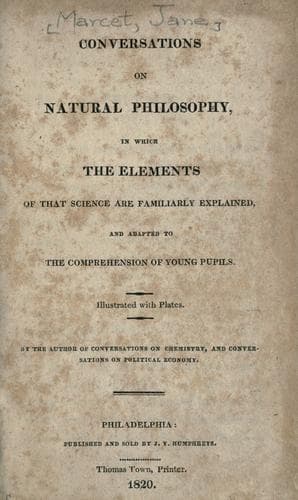
Conversations on Natural Philosophy, in which the Elements of that Science are Familiarly ExplainedMarcet, Mrs. (Jane Haldimand)
Science
Conversations on Natural Philosophy, in which the Elements of that Science are Familiarly Explained
Marcet, Mrs. (Jane Haldimand)
Physics
_Mrs. B._ The diminution of the force of gravity, at so small a distance
as that to which the atmosphere extends (compared with the size of the
earth) is so inconsiderable as to be scarcely sensible; but the pressure
of the upper parts of the atmosphere on those beneath, renders the air
near the surface of the earth much more dense than in the upper regions.
The pressure of the atmosphere has been compared to that of a pile of
fleeces of wool, in which the lower fleeces are pressed together by the
weight of those above; these lie light and loose, in proportion as they
approach the uppermost fleece, which receives no external pressure, and
is confined merely by the force of its own gravity.
_Emily._ I do not understand how it is that the air can be springy or
elastic, as the particles of which it is composed must, according to the
general law, attract each other; yet their elasticity, must arise from a
tendency to recede from each other.
_Mrs. B._ Have you forgotten what I told you respecting the effects of
heat, a fluid so subtile that it readily pervades all substances, and
even in solid bodies, counteracts the attraction of cohesion? In air the
quantity of heat interposed is so great, as to cause its particles
actually to repel each other, and it is to this that we must ascribe its
elasticity; this, however, does not prevent the earth from exerting its
attraction upon the individual particles of which it consists.
_Caroline._ It has just occurred to me that there are some bodies which
do not gravitate towards the earth. Smoke and steam, for instance, rise
instead of falling.
_Mrs. B._ It is still gravity which produces their ascent; at least,
were that power destroyed, these bodies would not rise.
_Caroline._ I shall be out of conceit with gravity, if it is so
inconsistent in its operations.
_Mrs. B._ There is no difficulty in reconciling this apparent
inconsistency of effect. The air near the earth is heavier than smoke,
steam, or other vapours; it consequently not only supports these light
bodies, but forces them to rise, till they reach a part of the
atmosphere, the weight of which is not greater than their own, and then
they remain stationary. Look at this bason of water; why does the piece
of paper which I throw into it float on the surface?
_Emily._ Because, being lighter than the water, it is supported by it.
_Mrs. B._ And now that I pour more water into the bason, why does the
paper rise?
_Emily._ The water being heavier than the paper, gets beneath it, and
obliges it to rise.
Public-domain text, read in full here on John Shaqi.
Reviews
Reviews
No reviews yet
Be the first to share your thoughts on this work.
Join the Discussion
Join the discussion
Sign in to leave a comment or review.
Sign InorCreate an account