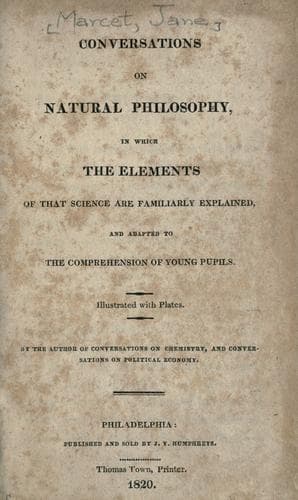
Conversations on Natural Philosophy, in which the Elements of that Science are Familiarly Explained — John Shaqi
Conversations on Natural Philosophy, in which the Elements of that Science are Familiarly ExplainedMarcet, Mrs. (Jane Haldimand)
Science
Conversations on Natural Philosophy, in which the Elements of that Science are Familiarly Explained
Marcet, Mrs. (Jane Haldimand)
Physics
_Mrs. B._ In a similar manner are smoke and vapour forced upwards by the
air; but these bodies do not, like the paper, ascend to the surface of
the fluid, because, as we observed before, the air being less dense, and
consequently lighter as it is more distant from the earth, vapours rise
only till they attain a region of air of their own density. Smoke,
indeed ascends but a very little way; it consists of minute particles of
fuel, carried up by a current of heated air, from the fire below: heat,
you recollect, expands all bodies; it consequently rarefies air, and
renders it lighter than the colder air of the atmosphere; the heated air
from the fire carries up with it vapour and small particles of the
combustible materials which are burning in the fire. When this current
of hot air is cooled by mixing with the atmosphere, the minute particles
of coal, or other combustible, fall; it is this which produces the small
black flakes which render the air, and every thing in contact with it,
in London, so dirty.
_Caroline._ You must, however, allow me to make one more objection to
the universal gravity of bodies; which is the ascent of air balloons,
the materials of which are undoubtedly heavier than air: how, therefore,
can they be supported by it?
_Mrs. B._ I admit that the materials of which balloons are made are
heavier than the air; but the air with which they are filled is an
elastic fluid, of a different nature from atmospheric air, and
considerably lighter; so that on the whole the balloon is lighter than
the air which it displaces, and consequently will rise, on the same
principle as smoke and vapour. Now, Emily, let me hear if you can
explain how the gravity of bodies is modified by the effect of the air?
_Emily._ The air forces bodies which are lighter than itself to ascend;
those that are of an equal weight will remain stationary in it; and
those that are heavier will descend through it: but the air will have
some effect on these last; for if they are not much heavier, they will
with difficulty overcome the resistance they meet with in passing
through it, they will be borne up by it, and their fall will be more or
less retarded.
_Mrs. B._ Very well. Observe how slowly this light feather falls to the
ground, while a heavier body, like this marble, overcomes the
resistance which the air makes to its descent much more easily, and its
fall is proportionally more rapid. I now throw a pebble into this tub of
water; it does not reach the bottom near so soon as if there were no
water in the tub, because it meets with resistance from the water.
Suppose that we could empty the tub, not only of water, but of air also,
the pebble would then fall quicker still, as it would in that case meet
with no resistance at all to counteract its gravity.
Public-domain text, read in full here on John Shaqi.
Reviews
Reviews
No reviews yet
Be the first to share your thoughts on this work.
Join the Discussion
Join the discussion
Sign in to leave a comment or review.
Sign InorCreate an account