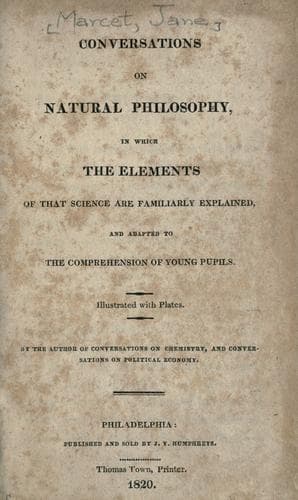
Conversations on Natural Philosophy, in which the Elements of that Science are Familiarly Explained — John Shaqi
Conversations on Natural Philosophy, in which the Elements of that Science are Familiarly ExplainedMarcet, Mrs. (Jane Haldimand)
Science
Conversations on Natural Philosophy, in which the Elements of that Science are Familiarly Explained
Marcet, Mrs. (Jane Haldimand)
Physics
Thus you see that it is not the different degrees of gravity, but the
resistance of the air, which prevents bodies of different weight from
falling with equal velocities; if the air did not bear up the feather,
it would reach the ground as soon as the marble.
_Caroline._ I make no doubt that it is so; and yet I do not feel quite
satisfied. I wish there was any place void of air, in which the
experiment could be made.
_Mrs. B._ If that proof will satisfy your doubts, I can give it you.
Here is a machine called an _air pump_, (fig. 2. pl. 1.) by means of
which the air may be expelled from any close vessel which is placed over
this opening, through which the air is pumped out. Glasses of various
shapes, usually called receivers, are employed for this purpose. We
shall now exhaust the air from this tall receiver which is placed over
the opening, and we shall find that bodies within it, whatever their
weight or size, will fall from the top to the bottom in the same space
of time.
_Caroline._ Oh, I shall be delighted with this experiment; what a
curious machine! how can you put the two bodies of different weight
within the glass, without admitting the air?
_Mrs. B._ A guinea and a feather are already placed there for the
purpose of the experiment: here is, you see, a contrivance to fasten
them in the upper part of the glass; as soon as the air is pumped out, I
shall turn this little screw, by which means the brass plates which
support them will be removed, and the two bodies will fall.--Now I
believe I have pretty well exhausted the air.
_Caroline._ Pray let me turn the screw.--I declare, they both reached
the bottom at the same instant! Did you see, Emily, the feather appeared
as heavy as the guinea?
_Emily._ Exactly; and fell just as quickly. How wonderful this is! what
a number of entertaining experiments might be made with this machine!
_Mrs. B._ No doubt there are a great many; but we shall reserve them to
elucidate the subjects to which they relate: if I had not explained to
you why the guinea, and the feather fell with equal velocity, you would
not have been so well pleased with the experiment.
_Emily._ I should have been as much surprised, but not so much
interested; besides, experiments help to imprint on the memory the facts
they are intended to illustrate; it will be better therefore for us to
restrain our curiosity, and wait for other experiments in their proper
places.
_Caroline._ Pray by what means is this receiver exhausted of its air?
_Mrs. B._ You must learn something of mechanics in order to understand
the construction of a pump. At our next meeting, therefore, I shall
endeavour to make you acquainted with the laws of motion, as an
introduction to that subject.
Questions
1. (Pg. 22) What are those properties of bodies called, which are not
common to all?
2. (Pg. 23) Why are they so called?
3. (Pg. 23) What is the cause of weight in bodies?
Public-domain text, read in full here on John Shaqi.
Reviews
Reviews
No reviews yet
Be the first to share your thoughts on this work.
Join the Discussion
Join the discussion
Sign in to leave a comment or review.
Sign InorCreate an account