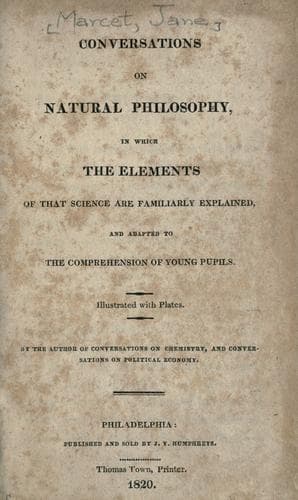
Conversations on Natural Philosophy, in which the Elements of that Science are Familiarly ExplainedMarcet, Mrs. (Jane Haldimand)
Science
Conversations on Natural Philosophy, in which the Elements of that Science are Familiarly Explained
Marcet, Mrs. (Jane Haldimand)
Physics
4. (Pg. 23) What is the reason that all bodies near to the surface of
the earth, are drawn towards it?
5. (Pg. 24) If attraction is the cause of weight, could you suppose it
possible for a body to possess the former and not the latter property?
6. (Pg. 24) When a stone falls to the ground, in which of the two bodies
does the power of attraction exist?
7. (Pg. 24) If the attraction be mutual, why does not the earth approach
the stone, as much as the stone approaches the earth?
8. (Pg. 24) If attraction be in proportion to the mass, why does not a
hill, draw towards itself, a house placed near it?
9. (Pg. 25) How can the attraction of a mountain be rendered sensible?
10. (Pg. 25) Why cannot two lines which are perpendicular to the surface
of the earth be parallel to each other?
11. (Pg. 26) Draw a small figure of the earth to exemplify this, as in
fig. 1. plate 1.
12. (Pg. 27) If bodies were not resisted by the air, those which are
light, would fall as quickly as those which are heavy, how can you
account for this?
13. (Pg. 27) What then is the reason that a book, and a sheet of paper,
let fall from the same height, will not reach the ground in the same
time?
14. (Pg. 28) What then will be the effect of increasing the surface of a
body?
15. (Pg. 28) What could you do to a sheet of paper, to make it fall
quickly, and why?
16. (Pg. 28) Inform me how a very dense body may be made to float in the
air?
17. (Pg. 28) The air is a real body, why does it not fall to the ground?
18. (Pg. 29) The air is more dense near the surface of the earth, and
decreases in density as you ascend, how is this accounted for, and to
what is it compared?
19. (Pg. 29) What is it which causes the particles of air to recede from
each other, and seems to destroy their mutual attraction?
20. (Pg. 29) Smoke and vapour ascend in the atmosphere, how can you
reconcile this with gravitation?
21. (Pg. 30) How would you illustrate this by the floating of a piece of
paper on water?
22. (Pg. 30) Does smoke rise to a great height in the air, and if not,
what prevents its so doing?
23. (Pg. 30) What limits the height to which vapours rise?
24. (Pg. 30) Of what does smoke consist?
25. (Pg. 30) Air balloons are formed of heavy materials, how will you
account for their rising in the air?
26. (Pg. 30) What influence does the air exert, on bodies less dense
than itself, on those of equal, and on those of greater density?
27. (Pg. 31) If the air could be entirely removed, what influence would
this have upon the falling of heavy and light bodies?
28. (Pg. 31) How could this be exemplified by means of the air pump?
CONVERSATION III.
ON THE LAWS OF MOTION.
Public-domain text, read in full here on John Shaqi.
Reviews
Reviews
No reviews yet
Be the first to share your thoughts on this work.
Join the Discussion
Join the discussion
Sign in to leave a comment or review.
Sign InorCreate an account