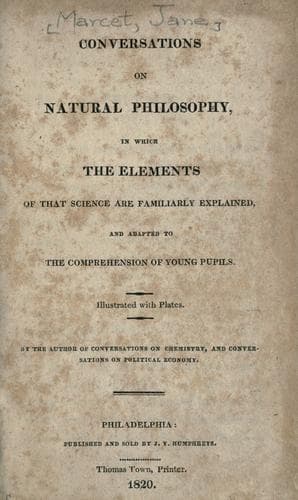
Conversations on Natural Philosophy, in which the Elements of that Science are Familiarly ExplainedMarcet, Mrs. (Jane Haldimand)
Science
Conversations on Natural Philosophy, in which the Elements of that Science are Familiarly Explained
Marcet, Mrs. (Jane Haldimand)
Physics
OF MOTION. OF THE INERTIA OF BODIES. OF FORCE TO PRODUCE MOTION.
DIRECTION OF MOTION. VELOCITY, ABSOLUTE AND RELATIVE. UNIFORM MOTION.
RETARDED MOTION. ACCELERATED MOTION. VELOCITY OF FALLING BODIES.
MOMENTUM. ACTION AND REACTION EQUAL. ELASTICITY OF BODIES. POROSITY OF
BODIES. REFLECTED MOTION. ANGLES OF INCIDENCE AND REFLECTION.
MRS. B.
The science of mechanics is founded on the laws of motion; it will
therefore be necessary to make you acquainted with these laws before we
examine the mechanical powers. Tell me, Caroline, what do you understand
by the word motion?
_Caroline._ I think I understand it perfectly, though I am at a loss to
describe it. Motion is the act of moving about, of going from one place
to another, it is the contrary of remaining at rest.
_Mrs. B._ Very well. Motion then consists in a change of place; a body
is in motion whenever it is changing its situation with regard to a
fixed point.
Now since we have observed that one of the general properties of bodies
is inertia, that is, an entire passiveness, either with regard to
motion or rest, it follows that a body cannot move without being put
into motion; the power which puts a body into motion is called _force_;
thus the stroke of the hammer is the force which drives the nail; the
pulling of the horse that which draws the carriage, &c. Force then is
the cause which produces motion.
_Emily._ And may we not say that gravity is the force which occasions
the fall of bodies?
_Mrs. B._ Undoubtedly. I have given you the most familiar illustrations
in order to render the explanation clear; but since you seek for more
scientific examples, you may say that cohesion is the force which binds
the particles of bodies together, and heat that which drives them
asunder.
The motion of a body acted upon by a single force, is always in a
straight line, and in the direction in which it received the impulse.
_Caroline._ That is very natural; for as the body is inert, and can move
only because it is impelled, it will move only in the direction in which
it is impelled. The degree of quickness with which it moves, must, I
suppose, also depend upon the degree of force with which it is impelled.
_Mrs. B._ Yes; the rate at which a body moves, or the shortness of the
time which it takes to move from one place to another, is called its
velocity; and it is one of the laws of motion, that the velocity of the
moving body is proportional to the force by which it is put in motion.
We must distinguish between absolute and relative velocity.
The velocity of a body is called _absolute_, if we consider the motion
of the body in space, without any reference to that of other bodies.
When, for instance, a horse goes fifty miles in ten hours, his velocity
is five miles an hour.
Public-domain text, read in full here on John Shaqi.
Reviews
Reviews
No reviews yet
Be the first to share your thoughts on this work.
Join the Discussion
Join the discussion
Sign in to leave a comment or review.
Sign InorCreate an account