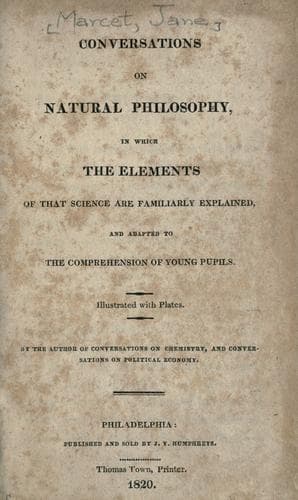
Conversations on Natural Philosophy, in which the Elements of that Science are Familiarly ExplainedMarcet, Mrs. (Jane Haldimand)
Science
Conversations on Natural Philosophy, in which the Elements of that Science are Familiarly Explained
Marcet, Mrs. (Jane Haldimand)
Physics
The velocity of a body is termed _relative_, when compared with that of
another body which is itself in motion. For instance, if one man walks
at the rate of a mile an hour, and another at the rate of two miles an
hour, the relative velocity of the latter is double that of the former;
but the absolute velocity of the one is one mile, and that of the other
two miles an hour.
_Emily._ Let me see if I understand it--The relative velocity of a body
is the degree of rapidity of its motion compared with that of another
body; thus if one ship sail three times as far as another ship in the
same space of time, the velocity of the former is equal to three times
that of the latter.
_Mrs. B._ The general rule may be expressed thus: the velocity of a
body is measured by the space over which it moves, divided by the time
which it employs in that motion: thus if you travel one hundred miles in
twenty hours, what is your velocity in each hour?
_Emily._ I must divide the space, which is one hundred miles, by the
time, which is twenty hours, and the answer will be five miles an hour.
Then, Mrs. B., may we not reverse this rule, and say that the time is
equal to the space divided by the velocity; since the space, one hundred
miles, divided by the velocity, five miles per hour, gives twenty hours
for the time?
_Mrs. B._ Certainly; and we may say also that the space is equal to the
velocity multiplied by the time. Can you tell me, Caroline, how many
miles you will have travelled, if your velocity is three miles an hour,
and you travel six hours?
_Caroline._ Eighteen miles; for the product of 3 multiplied by 6, is 18.
_Mrs. B._ I suppose that you understand what is meant by the terms
_uniform_, _accelerated_ and _retarded_ motion.
_Emily._ I conceive uniform motion to be that of a body whose motion is
regular, and at an equal rate throughout; for instance a horse that goes
an equal number of miles every hour. But the hand of a watch is a much
better example, as its motion is so regular as to indicate the time.
_Mrs. B._ You have a right idea of uniform motion; but it would be more
correctly expressed by saying, that the motion of a body is uniform when
it passes over equal spaces in equal times. Uniform motion is produced
by a force having acted on a body once and having ceased to act; as, for
instance, the stroke of a bat on a ball.
_Caroline._ But the motion of a ball is not uniform; its velocity
gradually diminishes till it falls to the ground.
_Mrs. B._ Recollect that the ball is inert, and has no more power to
stop, than to put itself in motion; if it falls, therefore, it must be
stopped by some force superior to that by which it was projected, and
which destroys its motion.
_Caroline._ And it is no doubt the force of gravity which counteracts
and destroys that of projection; but if there were no such power as
gravity, would the ball never stop?
Public-domain text, read in full here on John Shaqi.
Reviews
Reviews
No reviews yet
Be the first to share your thoughts on this work.
Join the Discussion
Join the discussion
Sign in to leave a comment or review.
Sign InorCreate an account