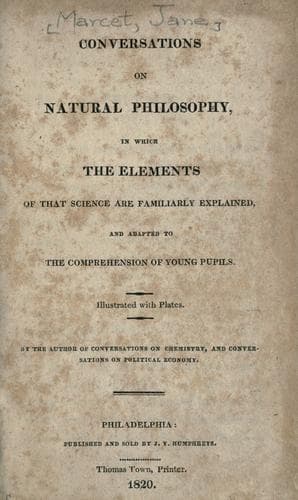
Conversations on Natural Philosophy, in which the Elements of that Science are Familiarly ExplainedMarcet, Mrs. (Jane Haldimand)
Science
Conversations on Natural Philosophy, in which the Elements of that Science are Familiarly Explained
Marcet, Mrs. (Jane Haldimand)
Physics
_Mrs. B._ If neither gravity nor any other force, such as the resistance
of the air, opposed its motion, the ball, or even a stone thrown by the
hand, would proceed onwards in a right line, and with a uniform velocity
for ever.
_Caroline._ You astonish me! I thought that it was impossible to
produce perpetual motion?
_Mrs. B._ Perpetual motion cannot be produced by art, because gravity
ultimately destroys all motion that human power can produce.
_Emily._ But independently of the force of gravity, I cannot conceive
that the little motion I am capable of giving to a stone would put it in
motion for ever.
_Mrs. B._ The quantity of motion you communicate to the stone would not
influence its duration; if you threw it with little force it would move
slowly, for its velocity you must remember, will be proportional to the
force with which it is projected; but if there is nothing to obstruct
its passage, it will continue to move with the same velocity, and in the
same direction as when you first projected it.
_Caroline._ This appears to me quite incomprehensible; we do not meet
with a single instance of it in nature.
_Mrs. B._ I beg your pardon. When you come to study the motion of the
celestial bodies, you will find that _nature_ abounds with examples of
perpetual motion; and that it conduces as much to the harmony of the
system of the universe, as the prevalence of it on the surface of the
earth, would to the destruction of all our comforts. The wisdom of
Providence has therefore ordained insurmountable obstacles to perpetual
motion here below; and though these obstacles often compel us to contend
with great difficulties, yet these appear necessary to that order,
regularity and repose, so essential to the preservation of all the
various beings of which this world is composed.
Now can you tell me what is _retarded motion_?
_Caroline._ Retarded motion is that of a body which moves every moment
slower and slower: thus when I am tired with walking fast, I slacken my
pace; or when a stone is thrown upwards, its velocity is gradually
diminished by the power of gravity.
_Mrs. B._ Retarded motion is produced by some force acting upon the body
in a direction opposite to that which first put it in motion: you who
are an animated being, endowed with power and will, may slacken your
pace, or stop to rest when you are tired; but inert matter is incapable
of any feeling of fatigue, can never slacken its pace, and never stop,
unless retarded or arrested in its course by some opposing force; and as
it is the laws of inert bodies of which mechanical philosophy treats, I
prefer your illustration of the stone retarded in its ascent. Now
Emily, it is your turn; what is _accelerated motion_?
Public-domain text, read in full here on John Shaqi.
Reviews
Reviews
No reviews yet
Be the first to share your thoughts on this work.
Join the Discussion
Join the discussion
Sign in to leave a comment or review.
Sign InorCreate an account