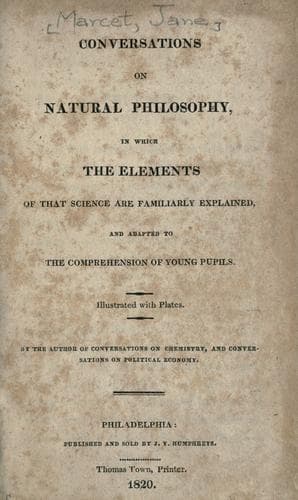
Conversations on Natural Philosophy, in which the Elements of that Science are Familiarly ExplainedMarcet, Mrs. (Jane Haldimand)
Science
Conversations on Natural Philosophy, in which the Elements of that Science are Familiarly Explained
Marcet, Mrs. (Jane Haldimand)
Physics
_Emily._ Accelerated motion, I suppose, takes place when the velocity of
a body is increased; if you had not objected to our giving such active
bodies as ourselves as examples, I should say that my motion is
accelerated if I change my pace from walking to running. I cannot think
of any instance of accelerated motion in inanimate bodies; all motion of
inert matter seems to be retarded by gravity.
_Mrs. B._ Not in all cases; for the power of gravitation sometimes
produces accelerated motion; for instance, a stone falling from a
height, moves with a regularly accelerated motion.
_Emily._ True; because the nearer it approaches the earth, the more it
is attracted by it.
_Mrs. B._ You have mistaken the cause of its accelerated motion; for
though it is true that the force of gravity increases as a body
approaches the earth, the difference is so trifling at any small
distance from its surface, as not to be perceptible.
Accelerated motion is produced when the force which put a body in
motion, continues to act upon it during its motion, so that its velocity
is continually increased. When a stone falls from a height, the impulse
which it receives from gravitation in the first instant of its fall,
would be sufficient to bring it to the ground with a uniform velocity:
for, as we have observed, a body having been once acted upon by a force,
will continue to move with a uniform velocity; but the stone is not
acted upon by gravity merely at the first instant of its fall; this
power continues to impel it during the whole time of its descent, and it
is this continued impulse which accelerates its motion.
_Emily._ I do not quite understand that.
_Mrs. B._ Let us suppose that the instant after you have let a stone
fall from a high tower, the force of gravity were annihilated; the body
would nevertheless continue to move downwards, for it would have
received a first impulse from gravity; and a body once put in motion
will not stop unless it meets with some obstacle to impede its course;
in this case its velocity would be uniform, for though there would be no
obstacle to obstruct its descent, there would be no force to accelerate
it.
_Emily._ That is very clear.
_Mrs. B._ Then you have only to add the power of gravity constantly
acting on the stone during its descent, and it will not be difficult to
understand that its motion will become accelerated, since the gravity
which acts on the stone at the very first instant of its descent, will
continue in force every instant, till it reaches the ground. Let us
suppose that the impulse given by gravity to the stone during the first
instant of its descent, be equal to one; the next instant we shall find
that an additional impulse gives the stone an additional velocity, equal
to one; so that the accumulated velocity is now equal to two; the
following instant another impulse increases the velocity to three, and
so on till the stone reaches the ground.
Public-domain text, read in full here on John Shaqi.
Reviews
Reviews
No reviews yet
Be the first to share your thoughts on this work.
Join the Discussion
Join the discussion
Sign in to leave a comment or review.
Sign InorCreate an account