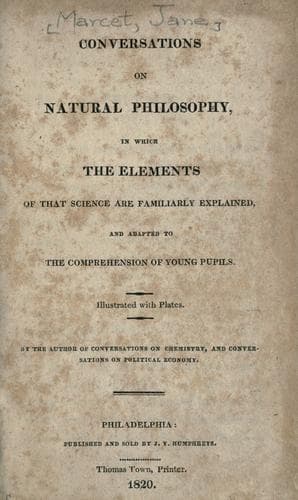
Conversations on Natural Philosophy, in which the Elements of that Science are Familiarly ExplainedMarcet, Mrs. (Jane Haldimand)
Science
Conversations on Natural Philosophy, in which the Elements of that Science are Familiarly Explained
Marcet, Mrs. (Jane Haldimand)
Physics
_Mrs. B._ Nature has assigned regular forms to many of her productions.
The natural form of various mineral substances is that of crystals, of
which there is a great variety. Many of them are very beautiful, and no
less remarkable by their transparency or colour, than by the perfect
regularity of their forms, as may be seen in the various museums and
collections of natural history. The vegetable and animal creation
appears less symmetrical, but is still more diversified in figure than
the mineral kingdom. Manufactured substances assume the various
arbitrary forms which the art of man designs for them; and an infinite
number of irregular forms are produced by fractures and by the
dismemberment of the parts of bodies.
_Emily._ Such as a piece of broken china, or glass?
_Mrs. B._ Or the masses and fragments of stone, and other mineral
substances, which are dug out of the earth, or found upon its surface;
many of which, although composed of minute crystals, are in the lump of
an irregular form.
We may now proceed to _divisibility_; that is to say, a susceptibility
of being divided into an indefinite number of parts. Take any small
quantity of matter, a grain of sand for instance, and cut it into two
parts; these two parts might be again divided, had we instruments
sufficiently fine for the purpose; and if by means of pounding,
grinding, and other similar methods, we carry this division to the
greatest possible extent, and reduce the body to its finest imaginable
particles, yet not one of the particles will be destroyed, but will each
contain as many halves and quarters, as did the whole grain.
The dissolving of a solid body in a liquid, affords a very striking
example of the extreme divisibility of matter; when you sweeten a cup of
tea, for instance, with what minuteness the sugar must be divided to be
diffused throughout the whole of the liquid.
_Emily._ And if you pour a few drops of red wine into a glass of water,
they immediately tinge the whole of the water, and must therefore be
diffused throughout it.
_Mrs. B._ Exactly so; and the perfume of this lavender water will be
almost as instantaneously diffused throughout the room, if I take out
the stopper.
_Emily._ But in this case it is only the perfume of the lavender, and
not the water itself that is diffused in the room.
_Mrs. B._ The odour or smell of a body is part of the body itself, and
is produced by very minute particles or exhalations which escape from
the odoriferous bodies. It would be impossible that you should smell the
lavender water, if particles of it did not come in actual contact with
your nose.
_Emily._ But when I smell a flower, I see no vapour rise from it; and
yet I perceive the smell at a considerable distance.
_Mrs. B._ You could, I assure you, no more smell a flower, the
odoriferous particles of which did not touch your nose, than you could
taste a fruit, the flavoured particles of which did not come in contact
with your tongue.
Public-domain text, read in full here on John Shaqi.
Reviews
Reviews
No reviews yet
Be the first to share your thoughts on this work.
Join the Discussion
Join the discussion
Sign in to leave a comment or review.
Sign InorCreate an account