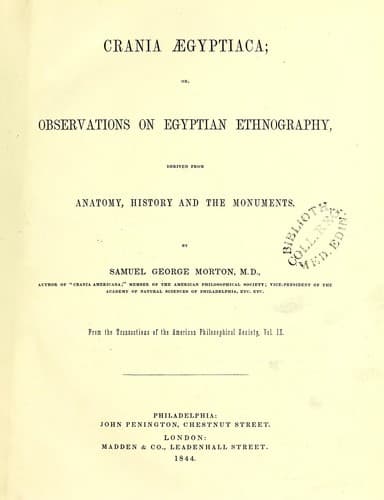
Crania Ægyptiaca: Or, Observations on Egyptian Ethnography Derived from Anatomy, History and the MonumentsMorton, Samuel George
History
Crania Ægyptiaca: Or, Observations on Egyptian Ethnography Derived from Anatomy, History and the Monuments
Morton, Samuel George
Craniology -- Egypt; Ethnology -- Egypt
The late Doctor Young, in his Hieroglyphical Literature, has given a
translation of a deed on papyrus of the reign of Ptolemy Alexander I.,
in which the parties to a sale of land at Thebes are described in the
following terms:—“Psammonthes, aged about 45, of middle size, dark
complexion and handsome figure, bald, round-faced and straight-nosed;
Snachomneus, aged about 20, of middle size, sallow complexion,
round-faced and straight-nosed; Semmuthis Persinei, aged about 22, of
middle size, sallow complexion, round-faced, flat-nosed, and of quiet
demeanour; and Tathlyt Persinei, aged about 30, of middle size, sallow
complexion, round face and straight nose, the four being children of
Petepsais of the leather-dressers of the Memnonia; and Necheutes the
less, the son of Azos, aged about 40, of middle size, sallow
complexion, cheerful countenance, long face and straight nose, with a
scar upon the middle of the forehead.” In another deed of the same
epoch, also translated by Dr. Young, an Egyptian named Anophris is
described as “tall, of a sallow complexion, hollow-eyed and bald.”
Independently of the value of the other physical characters preserved
in these documents, the remarks on complexion have a peculiar
interest; for they show that among six individuals of three different
families, one only had a dark complexion, and that all the rest were
sallow.
From the preceding facts, and many others which might be adduced, I
think we may safely conclude, that the complexion of the Egyptians did
not differ from that of the other Caucasian nations in the same
latitudes. That while the higher classes, who were screened from the
action of a burning sun, were fair in the comparative sense, the
middle and lower classes, like the modern Berbers, Arabs, and Moors,
presented various shades of complexion, even to a dark and swarthy
tint, which the Greeks regarded as black in comparison with their own.
To these diversities must also be added others incident to a vast
servile population, derived from all the adjacent nations, among which
the sable Negro stood forth in bold and contrasted characters.
Public-domain text, read in full here on John Shaqi.
Reviews
Reviews
No reviews yet
Be the first to share your thoughts on this work.
Join the Discussion
Join the discussion
Sign in to leave a comment or review.
Sign InorCreate an account