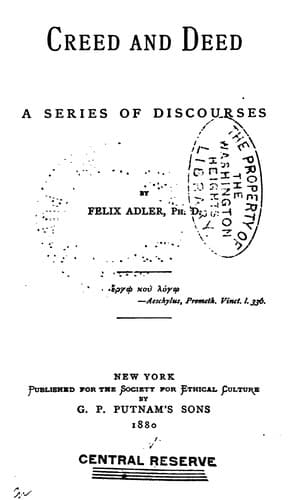
Creed and Deed: A Series of DiscoursesAdler, Felix
Religion
Creed and Deed: A Series of Discourses
Adler, Felix
Ethical culture movement; Ethics; Religion
There is also another element of belief associated with the doctrine of
the Messiah, which still more plainly illustrates the typical value of
religious tenets. In the coming week the churches throughout Christendom
will rehearse the story of the passion and the death of their founder.
Mournful chants and lamentations will recall every circumstance of the
dark drama that closed on Calvary. That tale of harrowing agony still
moves the hearts of millions as though it were a tale of yesterday. It
is the symbol of the suffering and the crucifixion of the whole human
race. "Ah, but our griefs he has borne, our sorrows he has carried, he
was wounded for our transgressions, he was bruised for our iniquities."
Hundreds of years before the birth of Christ, the author of these lines
transcribed in them the sad experience of the reformers of his day. He
does not refer to any one Messiah; he speaks of that legacy of sacrifice
which is the heritage of the great and good, the world over. For who can
help us when we are plunged in deepest anguish, when it seems as though
we must sink under the load of trouble, but one who has endured like
trials, endured and triumphed over them? It is the martyrdom of the pure
that has redeemed mankind from guilt and sin? There is this constant
atonement of the strong for the weak, of the good for the evil. As old
Paul Gerhard has it in his seventeenth century hymn:
"When utmost dread shall seize me,
That human heart can know,
Do thou from pain release me,
By thy great pain and woe."
The teachings of religion then have their source in the aspirations
of the human heart; are the echoes of our wishes and our hopes. Not
valueless on that account, but valuable only in so far as they express
in noble types, noble aspirations of our souls. It were sad indeed if
morality depended upon the certainty of dogma. On the contrary it
is true that all that is best and grandest in dogma, is due to the
inspiration of the moral law in man. The time will come when the tenets
of faith will no longer be narrowly understood as now; and while
their influence will still be great, they will cease to be harmful
and confining. They will be used as rare imagery, to deck the sublime
meanings which they symbolize; not as vessels that contain the absolute
truth, but as choice and beautiful vases, fit to hold the ever fresh and
ever blooming flowers of the ideal.
Public-domain text, read in full here on John Shaqi.
Reviews
Reviews
No reviews yet
Be the first to share your thoughts on this work.
Join the Discussion
Join the discussion
Sign in to leave a comment or review.
Sign InorCreate an account