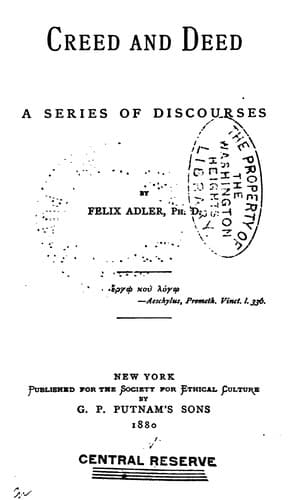
Creed and Deed: A Series of DiscoursesAdler, Felix
Religion
Creed and Deed: A Series of Discourses
Adler, Felix
Ethical culture movement; Ethics; Religion
The dogmatic assertion of religious teachings we hold to be a serious
evil, and dogma as such we cannot accept. Its influence in the past has
been pernicious, and is so at the present day no less. It has inflamed
the hatred of man against his brother man, it has led to the fatal error
of duties toward a personal Creator, distinct from our duties toward our
fellows: it has perverted the moral sense, by giving to the concern of
future salvation, a degree of prominence before which the interests
of the present life sink into comparative insignificance; it does not
afford us a common basis whereon we could unite, for it is by nature
uncertain and calculated to provoke dissensions. On the other hand we
behold in conscience the root of whatever good religion has achieved,
and the law of conscience must suffice to guide and elevate our lives.
To refresh the moral sentiment is the one thing needful in our time, and
indeed presents a task on whose accomplishment the highest interests of
society depend. Time will show that a simple appeal to duty will surely
suffice to lead men to more earnest exertions toward the good. Time will
show that those who know no other mode of salvation than the salvation
which is attained by works of love, will be at least as active in the
pursuit of virtue as those who put their trust in faith.
The gold of morality has been variously coined in the world's religious
systems. Various have been the symbols that were stamped thereon, and
various the images of the King in whose name it was issued, but
their value so far as they had value was in the moral gold that they
contained, and in naught else. Let Liberalism stamp its coin with the
Eagle of Liberty only, in its ethical teachings it will still retain the
substance of all religion.
Dogma we will keep in abeyance,--this is our point of departure, and
the deed superior to the creed. Be it ours to hold high the moral ideal,
whether we clothe it with personality or not. Be it ours to act divine
things, no matter how we regard divine mysteries. Be it ours to help in
lifting up the fallen, to lend free utterance to the complaints of
the oppressed, to brand the social iniquities of our time, to give our
hearts warmth and the labor of our hands to the cause of their redress,
and to push on with whatever power we may, the progress of our race
toward those high and holy goals of which the dreamers dream, the
prophets prophesy.
III. THE NEW IDEAL
Public-domain text, read in full here on John Shaqi.
Reviews
Reviews
No reviews yet
Be the first to share your thoughts on this work.
Join the Discussion
Join the discussion
Sign in to leave a comment or review.
Sign InorCreate an account