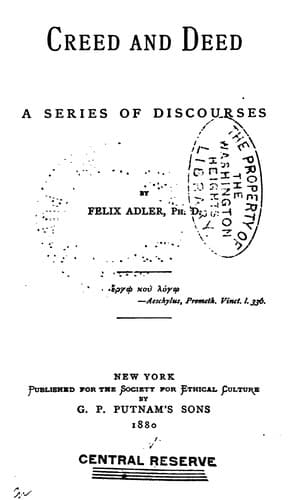
Creed and Deed: A Series of DiscoursesAdler, Felix
Religion
Creed and Deed: A Series of Discourses
Adler, Felix
Ethical culture movement; Ethics; Religion
The old religions and science are at war. With pitiless consistency
science directs its attack upon their vulnerable positions. The
conception of inexorable law subverts the testimony of miracles; the
fond belief in truths divinely revealed fails to withstand the searching
analysis of historical criticism; the battle of science is yet far from
being won, but from our standpoint the issue cannot appear doubtful. It
behooves us therefore to inquire into the moral bearings of the general
result thus far achieved and to review what we have lost and won.
Shall we succeed thereby in allaying the sense of alarm that is wont
to agitate the timid heart when it beholds so much that it confidently
believed a part of the everlasting verities of life, sink back into the
gulf of uncertainty and doubt?
We are standing at the portals of a new age, and new conceptions have
arisen of the purpose which we are here to accomplish and of the means
of help we can command in the attempt to realize our destiny. These
new conceptions we call The New Ideal. It is the purpose of our present
discourse to compare some salient features of the old and new.
The old and new Ideals agree in looking to an Infinite beyond the
borders of experience, for it is in the nature of the ideal to lift us
above the merely real. They differ in the direction in which they
seek their object, and the bias which they consequently give to men's
thoughts and actions. Theology, perceiving the inability of reason to
solve the problems of the beginning and the end, yet unable to
restrain a desire to know what is really unknowable, has impressed the
imagination into its service, and drawn a picture of the transcendental
world, conforming indeed to the analogies of man's terrestrial
existence, but on this account all the more adapted to answer the wishes
of the masses of mankind. Enough for them that they feel the need of
believing the picture true. We of the New School are, if possible,
even more profoundly convinced of the limitations of human reason. We
cheerfully accord to the religious conceptions of the past a poetic
value; they are poetry, often of the sublimest kind; but we cannot
deceive ourselves as to the noble weakness of the heart to which they
owe their origin; we cannot forget that in their case alas the wish
has been father to the thought. To us the mystery is still mystery--the
veiled arcana are not revealed, the riddle is unread. But we are not
therefore filled with terror or dismay. In the moral nature of man we
discover a divine element. In the voice of conscience we hear the voice
of the present divinity within us, and we learn to regard this mortal
state of ours as a channel through which the currents of Eternity ebb
and flow ceaselessly. The divine nature is not far off, nor beyond the
sea; in our own hearts on our own lips!
Public-domain text, read in full here on John Shaqi.
Reviews
Reviews
No reviews yet
Be the first to share your thoughts on this work.
Join the Discussion
Join the discussion
Sign in to leave a comment or review.
Sign InorCreate an account