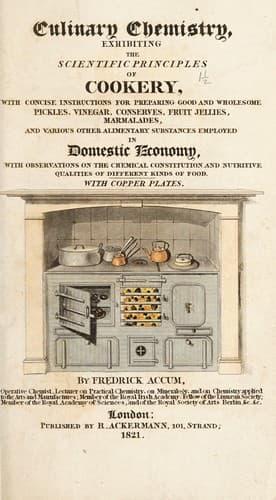
Culinary Chemistry: The Scientific Principles of Cookery, with Concise Instructions for Preparing Good and Wholesome Pickles, Vinegar, Conserves, Fruit Jellies, Marmalades, and Various Other Alimentary Substances Employed in Domestic Economy, with Observations on the Chemical Constitution and Nutritive Qualities of Different Kinds of Food.Accum, Friedrich Christian
Science
Culinary Chemistry: The Scientific Principles of Cookery, with Concise Instructions for Preparing Good and Wholesome Pickles, Vinegar, Conserves, Fruit Jellies, Marmalades, and Various Other Alimentary Substances Employed in Domestic Economy, with Observations on the Chemical Constitution and Nutritive Qualities of Different Kinds of Food.
Accum, Friedrich Christian
Cooking; Food poisoning
Roasting in a closed oven, or _baking_, consists in exposing substances
to be roasted to the action of heat in a confined space, or closed oven,
which does not permit the free access of air, to cause the vapour
arising from the roasted substance to escape as fast as it is formed,
and this circumstance materially alters the flavour of roasted animal
substances.
_Roasters_ and ovens of the common construction are apt to give the meat
a disagreeable flavour, arising from the empyreumatic oil, which is
formed by the decomposition of the fat, exposed to the bottom of the
oven. This inconvenience has been completely remedied in two ways, by
providing against the evil of allowing the fat to burn; and secondly,
by carrying out of the oven by a strong current of heated air, the
empyreumatic vapours, as fast as they are formed.
Such are the different processes of roasting meat.
_Rationale._--The first effect of the fire is to rarify the watery
juices within its influence which make their escape in the form of
steam. The albuminous portion then coagulates in the same manner as the
white of an egg does, the gelatine and the osmazome[21] become detached
from the fibrine, and unite with a portion of the fat, which also is
liquified by the expansive property of heat. The union of these form a
compound fluid not to be found in the meat previously. This is retained
in the interstices of the fibres where it is formed by the brown frothy
crust, but flows abundantly from every pore when a cut is made into the
meat with a knife. In consequence of the dissipation of the watery
juices, the fibrous portion becomes gradually corrugated, and, if not
attentively watched, its texture is destroyed, and it becomes rigid.
Chemists prove that the peculiar odour and taste of roasted meat depends
on the development of the principle which has been called _osmazome_, or
the _animal extractive matter_ of the old chemist, a substance which
differs very much from every other constituent part of animal matter
_chemically_, in being soluble in alcohol--and to the _senses_, in being
extremely savoury or sapid. It is upon this principle, which seems to
admit of considerable varieties, that the peculiar grateful flavour of
animal food, (whether in the form of broth or roasted,) and of each of
its kinds, depends. Osmazome exists in the largest quantity in the
fibrous organs, or combined with fibrine in the muscles, while the
tendons and other gelatinous organs appear to be destitute of it. The
flesh of game, and old animals, contains it in greater quantity than
that of young animals abounding in gelatine.
[21] Derived from οσμη, _smell_, and ζωμος, _broth_.
Reviews
Reviews
No reviews yet
Be the first to share your thoughts on this work.
Join the Discussion
Join the discussion
Sign in to leave a comment or review.
Sign InorCreate an account